“Report immediately.” Those two words, sent in a telegram, set Jean Bartik on an unexpected path with global impact. Jean graduated from Stanberry High School in rural Missouri in 1941 at the age of 16. She ranked as salutatorian and earned the highest score in mathematics, later graduating with a mathematics degree from Northwest Missouri State Teachers College in 1945. After deciding not to pursue a career in teaching, she answered a U.S. Army advertisement seeking math majors for a special project at the Moore School of Electrical Engineering at the University of Pennsylvania.
Bartik was not alone: alongside Kathleen Rita Antonelli, Frances “Betty” Snyder Holberton, Marlyn Wescoff Meltzer, Frances Bilas Spence, and Ruth Lichterman Teitelbaum, six women from ordinary backgrounds became part of an extraordinary story.
During World War II, the U.S. Army faced the challenge of accurately calculating artillery trajectories. These calculations required accounting for variables such as weather, which could affect the angle and accuracy of artillery equipment. With many male mathematicians deployed or assigned to other war projects, the Army turned to women, recruiting and training almost 100 as human “computers” at the Moore School.
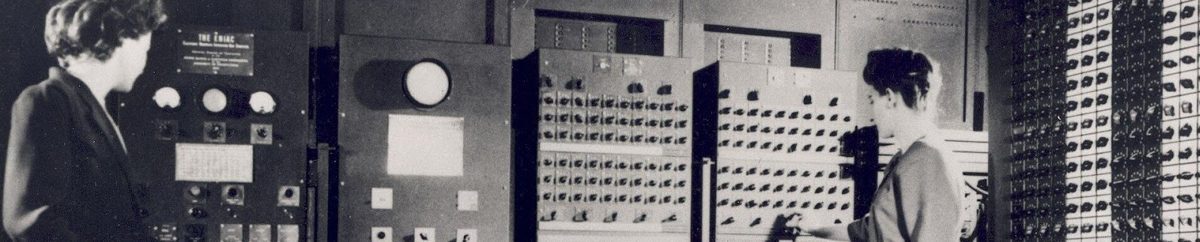
Solving thousands of complex equations by hand–each trajectory calculation taking nearly 40 hours to complete–was impossible given wartime demands. Machines such as the differential analyzer reduced this time to minutes, but even these advancements could not keep up with demand. In late 1943, a top-secret project began to build a faster solution: the Electronic Numerical Integrator and Computer (ENIAC), designed by physicist John Mauchly and electrical engineer J. Presper Eckert.
In 1945, the Army selected the six women to program ENIAC, at first without formal training or direct access to the machine due to security restrictions. Working only from diagrams, they taught themselves how ENIAC functioned and became its first programmers, transforming the machine into a working ballistic trajectory calculator.
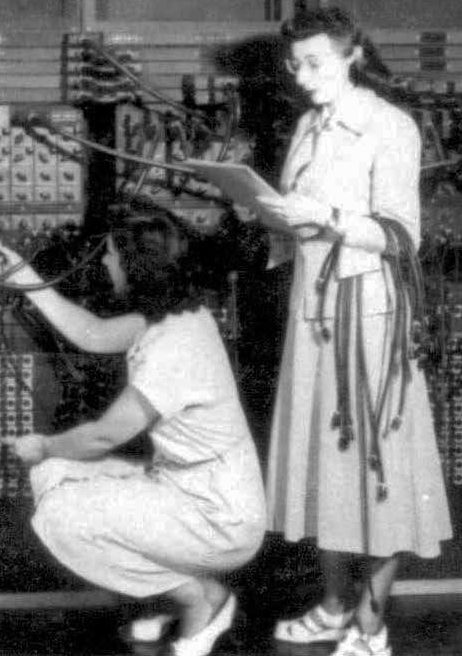
When ENIAC was publicly unveiled on February 15, 1946, Mauchly and Eckert were celebrated as its creators. Although the women appeared in media photographs, they were neither publicly acknowledged nor given credit for their critical contributions to its programming and operation.
Although ENIAC later played a key role in calculations for the hydrogen bomb, the women’s contributions to the program's success were largely forgotten for decades. Only later in their lives, thanks to the efforts of female programmers who followed, did they finally receive recognition. In 1997, the ENIAC Six were inducted into the Women in Technology International Hall of Fame.
Alongside their numerous groundbreaking successes in their field, the ENIAC Six stand as role models to women in STEM whose efforts often go unnoticed. The echoes of ENIAC can be felt today in organizations that uplift women in technology, such as Girls Who Code. Their legacy reminds us that illuminating untold histories can help unlock the unseen potential in future generations.