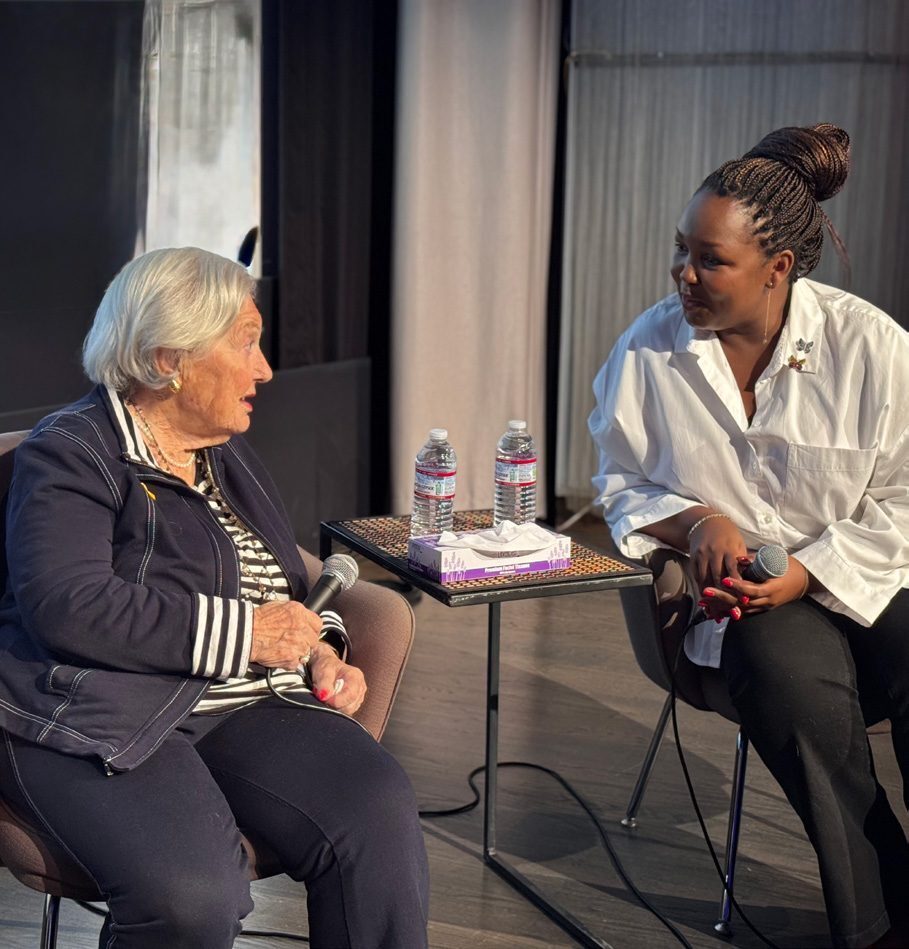
On an early July day, two women of different ages, backgrounds, and experiences, in many ways more different than alike, entered a room. Ella Mandel, a 100-year-old Holocaust survivor, and Dydine Umunyana-Anderson, a survivor of the Genocide Against the Tutsi in Rwanda, sixty years her junior, came together from different times, corners of the world and different lived experiences—united by their strong call to action to share their powerful stories and to shape a better world through testimony.
Each woman took her seat, invited to share her testimony. When their stories had been told, they turned toward one another. Without a word being uttered, they clasped hands and exchanged a look of profound wordless understanding.
They had both experienced unimaginable pain and suffering, but they had survived. Speaking directly to the camera, Dydine said, “it’s one thing to survive; it’s another to survive after surviving.” Her words perfectly capture the depth of resilience.
There is a prevailing belief that bringing different atrocities into the same conversation leads to comparison and risks of false equivalencies. This can happen when discussions are approached thoughtlessly, without sufficient historical understanding, or sensitivity to victims and survivors (United States Holocaust Memorial Museum, 2018). On the other hand, if the purpose is clear, with connection rather than comparison as the aim, then such conversations can be thoughtful, grounded in historical accuracy, and with great care afforded to victims and survivors. While comparison often leads to greater division, connection has the power to inspire understanding, compassion, and unity. In fact, as Michael Rothberg (2009) suggests in his work on “multidirectional memory” memories of violence and atrocity need not compete with one another. Instead, they can illuminate one another, creating a richer, more interconnected understanding of human resilience.
The belief that atrocities should not be discussed together often stems from inherent biases and fears of dishonoring individual histories. By recognizing these biases yet remaining open, we can move beyond comparison toward dialogue that honors distinct experiences while acknowledging shared human emotions and lessons.
At the Museum of Tolerance, two of our core pedagogical principles are “Begin in Story, End in Story,” emphasizing the transformative nature of bearing witness to other’s stories and “Emotion as a Source of Knowledge,” recognizing the profound opportunity for even deeper connection with history by letting your heart into the experience as well as your mind. We believe that it just isn’t possible to not be affected by the stories of others. Even when survivors have not directly experienced each other’s trauma, they can connect through shared universal human emotions such as loss, fear, anger, and grief, showing us their infinite wells of compassion and understanding. Our survivors’ capacity for empathy reminds us how understanding can deepen into compassion, and that we possess a limitless capacity for showing care for one another. Empathy does not lessen when given, and our remarkable survivors encourage us to tap into our own capacity for understanding and care. Humans are complex beings, capable of experiencing a multitude of emotions, even those that seem to be in opposition.

These connections and emotions dig into the core of human experience. We ask ourselves what we might offer them by bearing witness, and what we might gain through truly listening. Can we also be deeply affected just by bearing witness? Can we find ourselves challenged by the difficult question of why humanity continues to cause harm and violence on its own, across time and space?
Can we learn something about the bravery of individuals? Can we give them the respect of sitting quietly and holding space for voices that were once almost silenced? Can we allow ourselves to be affected by the moments in their testimonies when they are no longer recalling, but seem to be reliving their experiences? Can we recognize heroism in the survival of everyday people? Through engaging with these questions, we remind ourselves that honoring these stories does not mean weighing them against one another. We reject hierarchies of suffering through our dialogic approach to engaging with these events, and by committing to uphold the ethos that Ella and Dydine already embody, as they honor each story with equal dignity, compassion, and respect.
Key Terms
Key terms
- Echo Circles
- Overlapping emotional and/or moral resonances that may occur when reflecting on separate historical events, with each event's historical contexts remaining distinct.
- Bearing Witness
- A practice, emphasized by Auschwitz survivor Elie Wiesel in his book Night, in which listeners take on the responsibility not just to hear, but to listen to understand so they can carry forward what was shared in the testimony of others.
- Cultural Relativism
- The individual's self-awareness and respectful understanding that others view interactions, practices, events and daily life through the lens of their own unique culture.
- Confirmation Bias
- The tendency to seek out, interpret, and remember information that supports one’s existing beliefs, while discounting evidence that challenges them.
- Identity Attachment
- The strong emotional connection someone forms with specific aspects of their identity, which can shape emotional reactions, especially when those identities feel challenged or threatened.
- Dialogic Thinking
- Part of the concept of multidirectional memory, created by Michael Rothberg in Multidirectional Memory: Remembering the Holocaust in the Age of Decolonization (2009), which suggests that collective memories of different atrocities don’t have to compete. Instead, they can converse with, borrow from, and echo one another in a complex, non-linear, and interactive process.