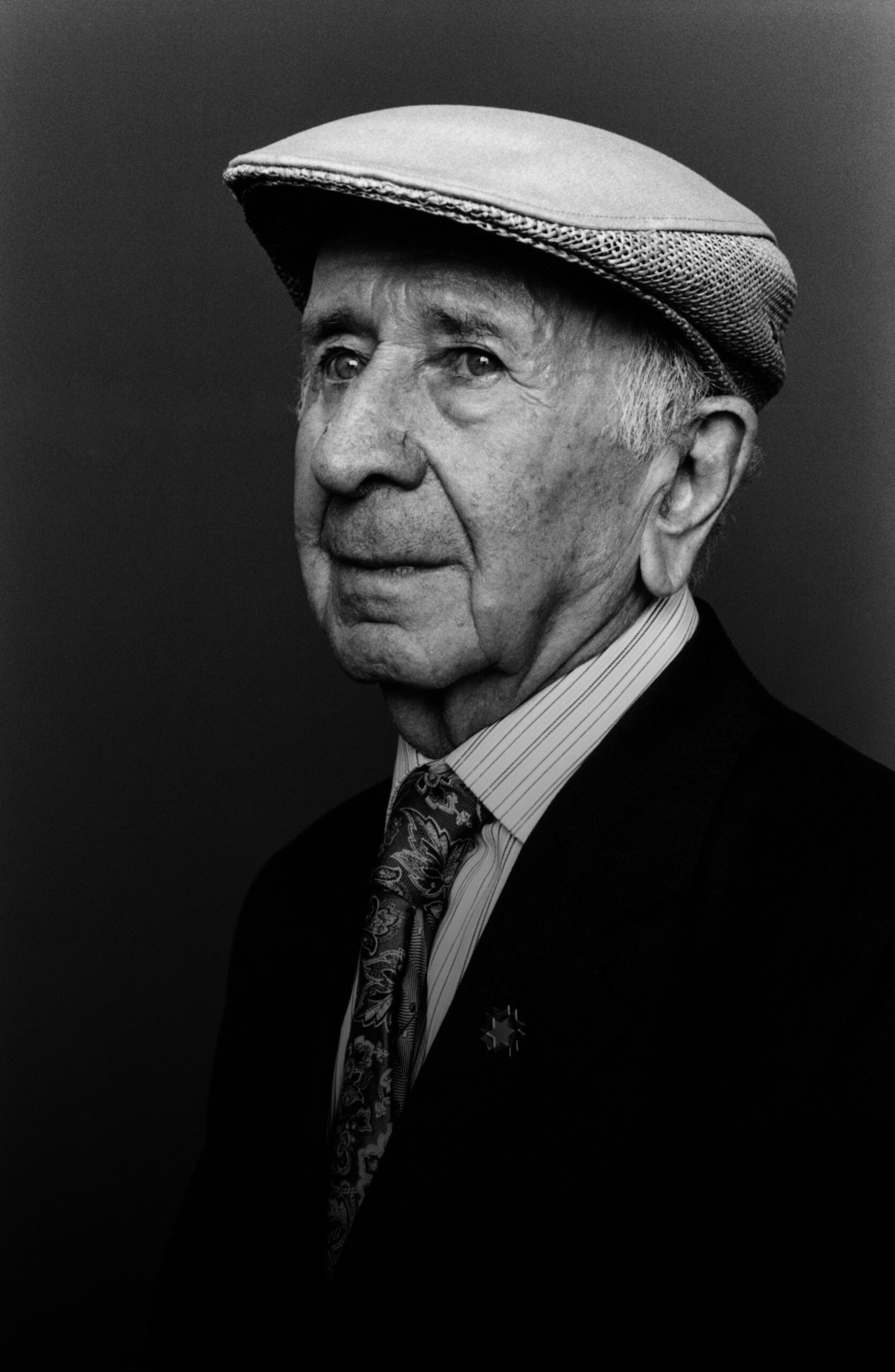
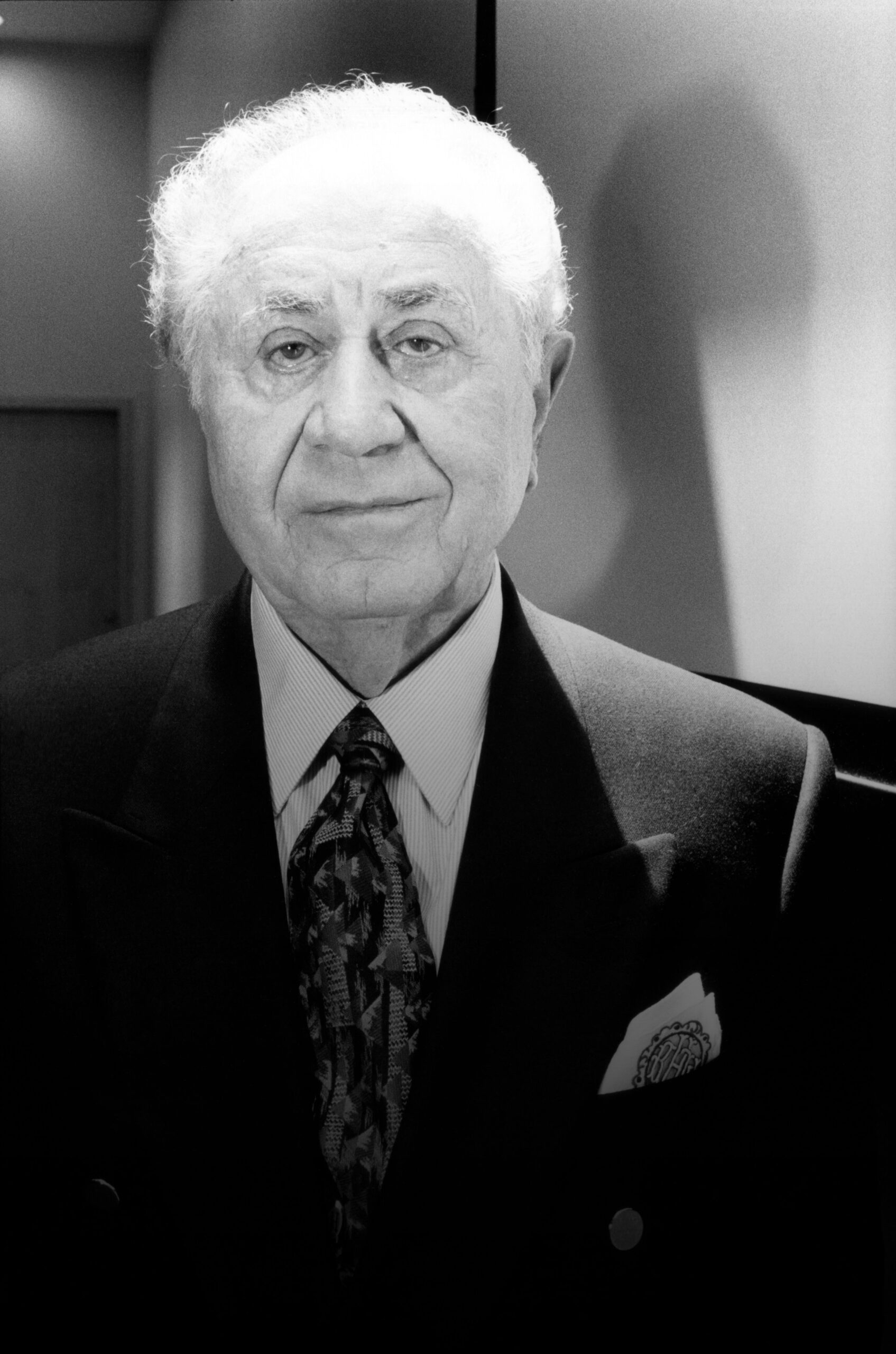
William “Bill” Harvey
My mother always said that religion is in your heart. Be kind to all of your fellow men.
William (“Bill”) Harvey was born Vilmos Herskovits to parents Zali and Aaron Herskovitz in Berehovo, Czechoslovakia on May 20, 1924. The town of Berehovo had a population of approximately 26,000 people, half of whom were Jewish. Bill was the youngest of six children; he had four sisters and one brother. His father was in the wine business while his mother was a homemaker. Bill first heard about Hitler on the radio when he was about 12 years old. He became acutely aware of the Polish Jews who had escaped to his town to hide. Bill’s brother died in 1930, and two of his sisters moved to Brussels with false Christian papers in 1933.
Bill was fortunate to complete his schooling and to graduate when he was eighteen, even though by 1941 only six percent of Jewish children were able to attend school. In December 1943, Bill’s father was beaten to death by the Nazis. Three weeks later, Bill, his mother, two sisters, and the remaining Jews of the town were transported to the Berehovo Ghetto where Bill worked in the infirmary. The ghetto was in an abandoned brick factory with no roof. Bill and his family were exposed to the severe winter weather. The sanitation in the ghetto was very poor, and there was little food available.
After about six weeks in the ghetto, Bill, his mother and his two sisters were transported in closed cattle cars to Auschwitz-Birkenau Death Camp. His mother was sent directly to the gas chamber, while he and his sisters were sent to work. There were mounds of corpses piled up in front of the barracks every morning. Sometimes, bodies would lie decomposing for three or four days.
The prisoners had very little food to eat; they were separated into groups of six and forced to share one small bowl of soup without utensils. After about 11 days in the camp, Bill should have received a tattoo but instead, he was pulled out of line and placed in a cattle car that took him through the Bavarian mountains to Buchenwald Concentration Camp. Upon arriving at Buchenwald, the prisoners were stripped naked, their heads were shaved, and Bill was dumped into a tub of chemicals. He then was forced to sit on the floor of a shower room which the Nazi guards said was a gas chamber. For two days, his skin and eyes burned from the strong chemicals.
In Buchenwald, by coincidence, Bill reunited with his brother-in-law, who had been arrested by the Nazis when he was disguised as a Christian resistance fighter. However, seven days later, Bill was transported to work at a gasoline refinery factory in Leuna, near Leipzig, Germany, where he worked from spring to September 1944. In March 1945, he was transported back to Buchenwald.
He appeared so cold and frozen that he was taken directly to the crematorium. Fortunately, one of the prisoners discovered that he was alive, took him to the infirmary and saved his life. While in Buchenwald, he once again reunited with his brother-in-law. On April 4, 1945, the American Army liberated Buchenwald. Bill was 21-years-old and weighed 72 pounds.
After the war, Bill and his brother-in-law traveled to Brussels, Belgium, where they were reunited with one of Bill’s sisters, who had been hiding as a Christian. They stayed in Belgium for about two months. Bill was also able to locate his two other sisters and some cousins in a Displaced Persons Camp in Germany. From 1945 to 1946, Bill worked at the United Nations (UNRA) distributing food to displaced people living in the surrounding towns.
In 1946, Bill and one of his sisters boarded an army boat headed for New York City. They arrived on August 31, 1946. Bill began working as an errand boy for a cosmetology office in Manhattan.
He learned English and stayed in the city for three and a half years. On March 3, 1950, Bill decided to come to California to visit his uncle, and he never left. He received his high school diploma from Roosevelt High School at the age of 26 and obtained a license in cosmetology in 1950. In 1953, he opened his own successful cosmetic house in Beverly Hills and married a native Californian, June Gardener, after knowing her for only three months. They were married for 42 happy years before she passed away. They had two daughters, Laurie and Wendy, four grandsons – Steven, Daniel, Matthew, and Kevin – and a precious great-granddaughter, Sienna.
Bill began speaking at the Museum of Tolerance in 2006 to educate the younger generation and to speak for those who never spoke up against the injustices they suffered. He has inspired many thousands of listeners with his words of inspiration and hope – students, educators, law enforcement professionals, and even incarcerated youth at prisons.
Bill ended each of his presentations with the prophetic words of poet Edwin Markham: “There is a destiny that makes us brothers; none goes his way alone. All that we send into the lives of others, comes back into our own.” Bill Harvey z”l passed away on March 31, 2022. His legacy lives on at the Museum of Tolerance.
His memory will forever be a blessing.
Z”L stands for the Hebrew words meaning “may his/her memory be a blessing.”