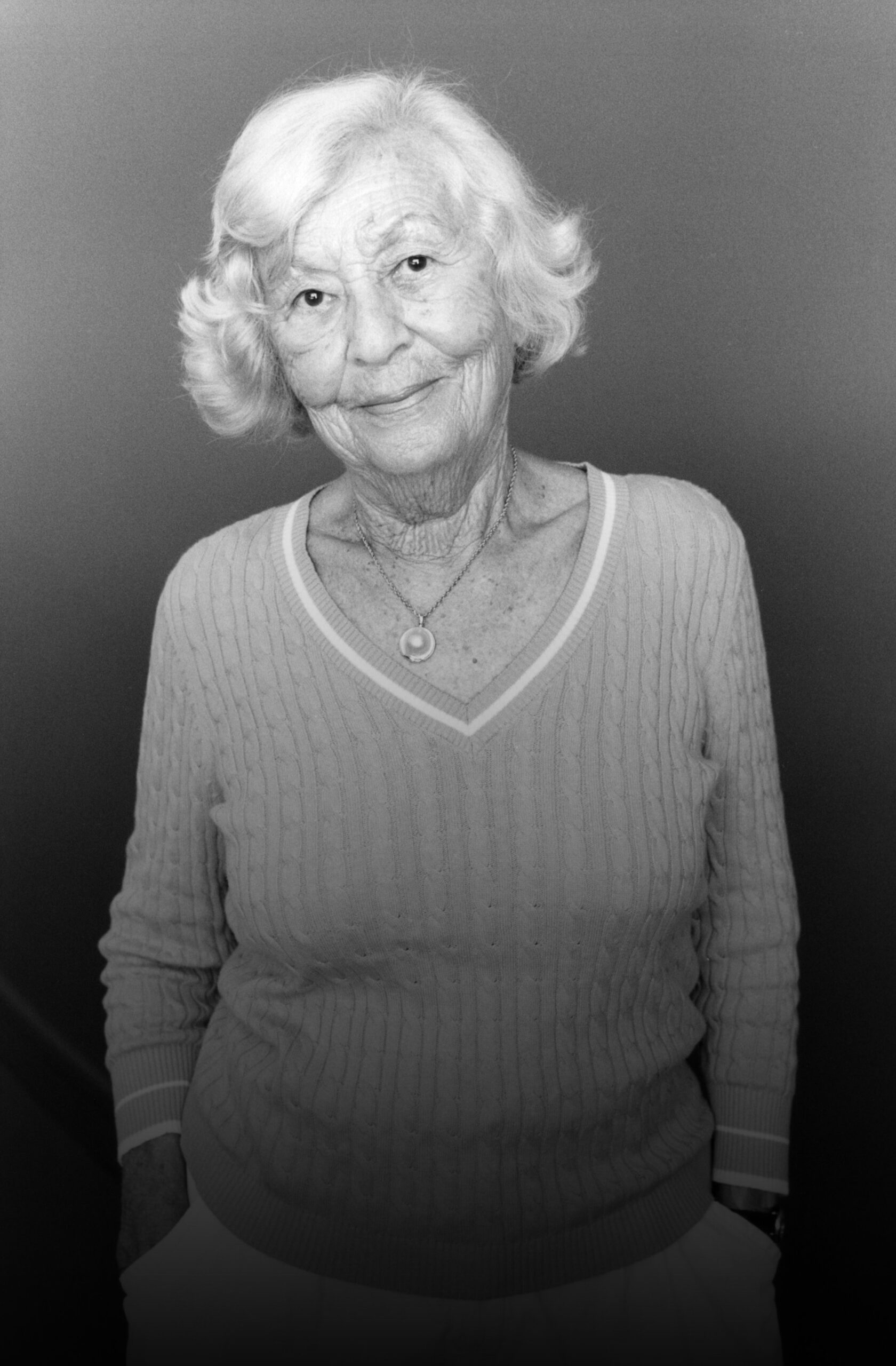
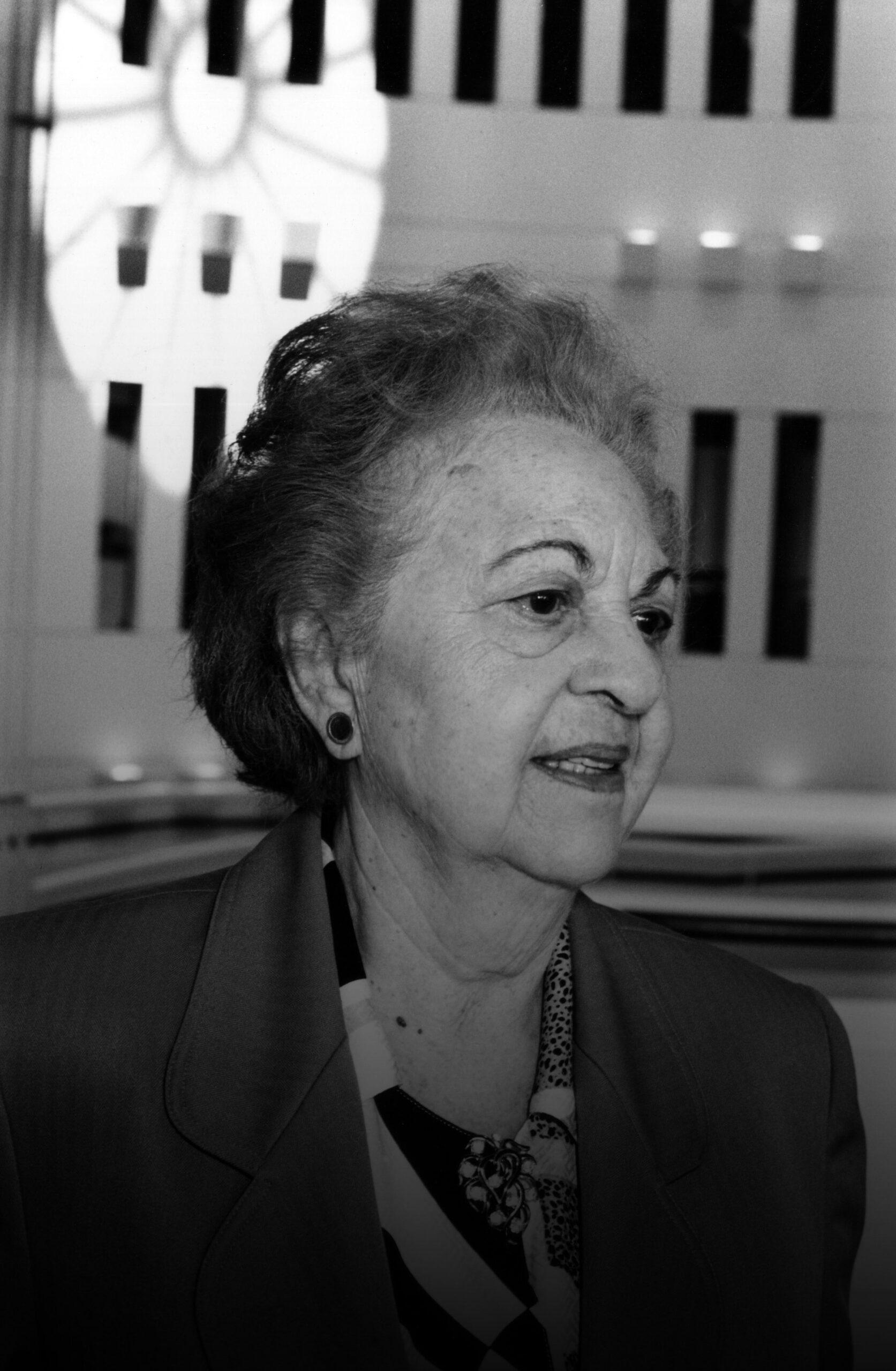
Mary Natan
Learn from history.
Mary Natan was born Maniusia Rybowski to Bertha and Shaya Rybowski on April 29, 1929, in Lodz, Poland. She was the youngest of five children. Her father owned a dance school and nightclub, while her mother remained home to raise the children. It was not until Mary was older that she started to hear about Hitler and the possibility of another war. Most people believed that Germany was so weak after losing WWI that it would not launch another war so soon. However, in 1939, Hitler invaded Poland and conquered the entire country in merely three weeks.
After the Nazi invasion, Jews were forcibly removed from their homes and put into ghettos. Mary’s family was relocated to the Lodz Ghetto. Life in the ghetto was like life in a prison. There were barbed-wire fences and armed guards stationed at the gates. Food and water were scarce or often unavailable and, within a year, all of the grass had been eaten by the prisoners. Disease was widespread and there were several outbreaks of E. Coli and typhoid fever. With no access to medicine, thousands of people died each week.
In 1941, Mary’s mother and her two brothers were deported from the ghetto. Mary and her father remained in the ghetto and survived as best they could. The Nazis evacuated the rest of the ghetto in 1944, deporting all inhabitants to concentration camps. Mary was forced onto a crowded cattle car, where she and the other prisoners were treated like animals and were unable to sit or lie down. Several days later, the train arrived at Auschwitz-Birkenau Extermination Camp. Men were immediately separated from women, and they were forced to form two lines for the “selection process.” On one side were the able-bodied people the Nazis deemed eligible for work; on the other were the sick, elderly, and children who were to be gassed immediately. Mary was sent to the left, to be gassed; but when the guards were distracted, she ran to the other line to join her cousin. This quick decision saved her life.
At Auschwitz-Birkenau the women were housed in 30 barracks and were permitted to use latrines only once a day. They slept in three-tier bunks, 16 girls per bunk. The camp was enclosed by electric wire fences that could electrocute a person with a single touch. The Nazis soon discovered that some children who were meant to be gassed had escaped to the other line during inspection. So they sent Mary and some other children to a large “children’s barrack” with no beds. She realized instantly that they were going to be killed.
Suddenly, a female prisoner handed Mary a scarf and a bucket of excrement and told her to follow. Claiming to be part of a cleaning unit, they walked past the guards and were allowed to leave. She was saved again.
Mary was then sent to Bergen-Belsen Concentration Camp, where starvation and disease were rampant. In late 1944, Mary was moved to a factory in Saxony, Germany. She remained there until April 16, 1945, when she was liberated by American forces. She was sent to a displaced persons camp in Germany, where she discovered that all four of her siblings had survived the Holocaust, as had her cousin. They were called the “Lucky Rybowskis.” Mary learned that she was the youngest survivor from Lodz.
In 1947, at the age of 16, Mary and her brother immigrated to the United States as part of Eleanor Roosevelt’s adoption program. She was sent to Philadelphia to live with a foster family but later moved to Texas and eventually to Los Angeles. Mary was married for 32 years to American-born, Milton Gelfman before Milton passed away. They had two sons, Stephen and Ronald, and a daughter, Shelley. Later, Mary married Jerry Natan, a Holocaust survivor, whose children also loved Mary.
Mary took part in a movie, “A Generation Apart,” and began speaking at the Museum of Tolerance in 2009 to give a voice to the one and a half million Jewish children murdered in the Holocaust. Mary Natan z”l passed away in 2020. Her memory and legacy will live on at the Museum of Tolerance.
Z”L stands for the Hebrew words meaning “may his/her memory be a blessing.”