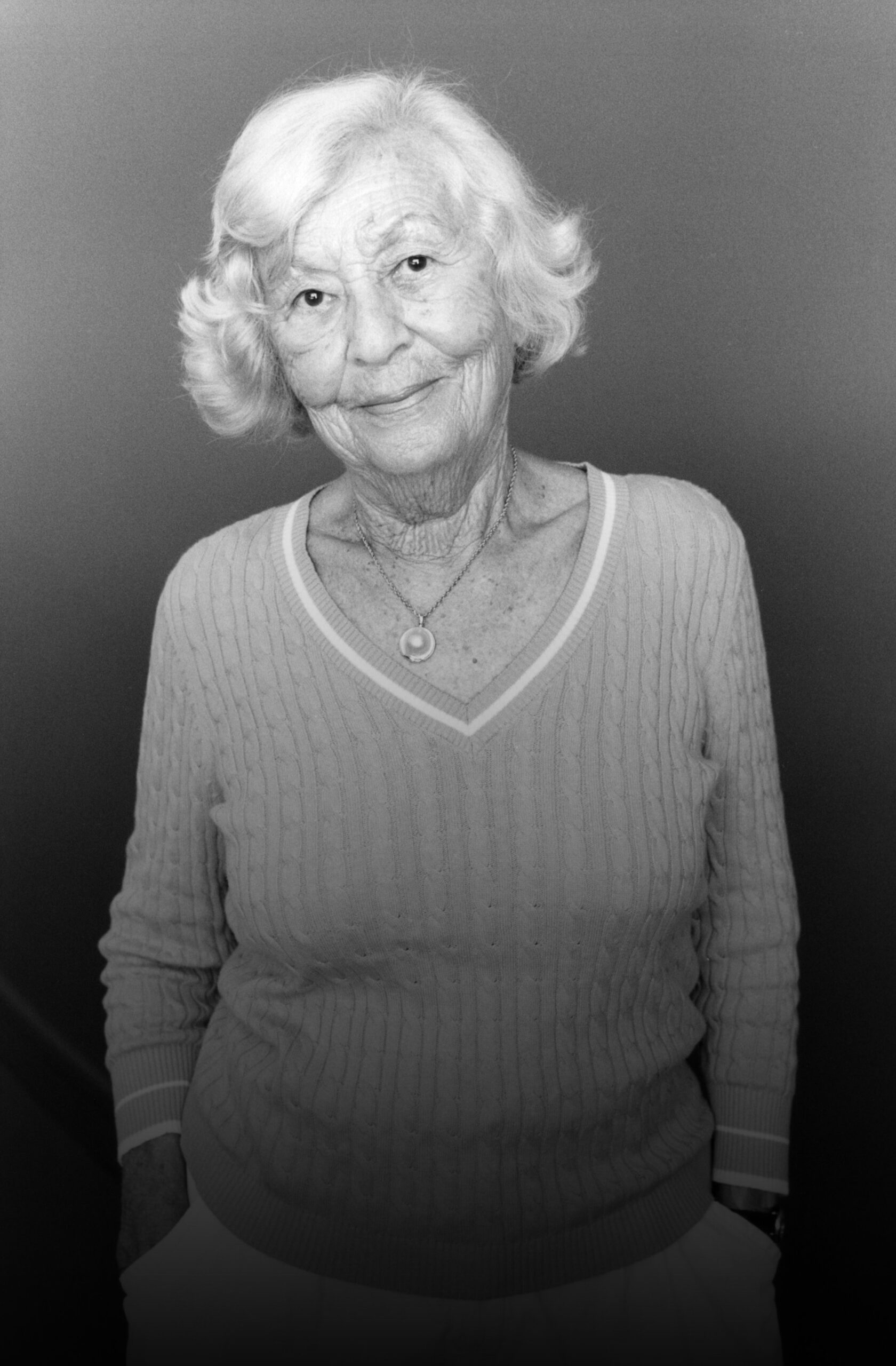
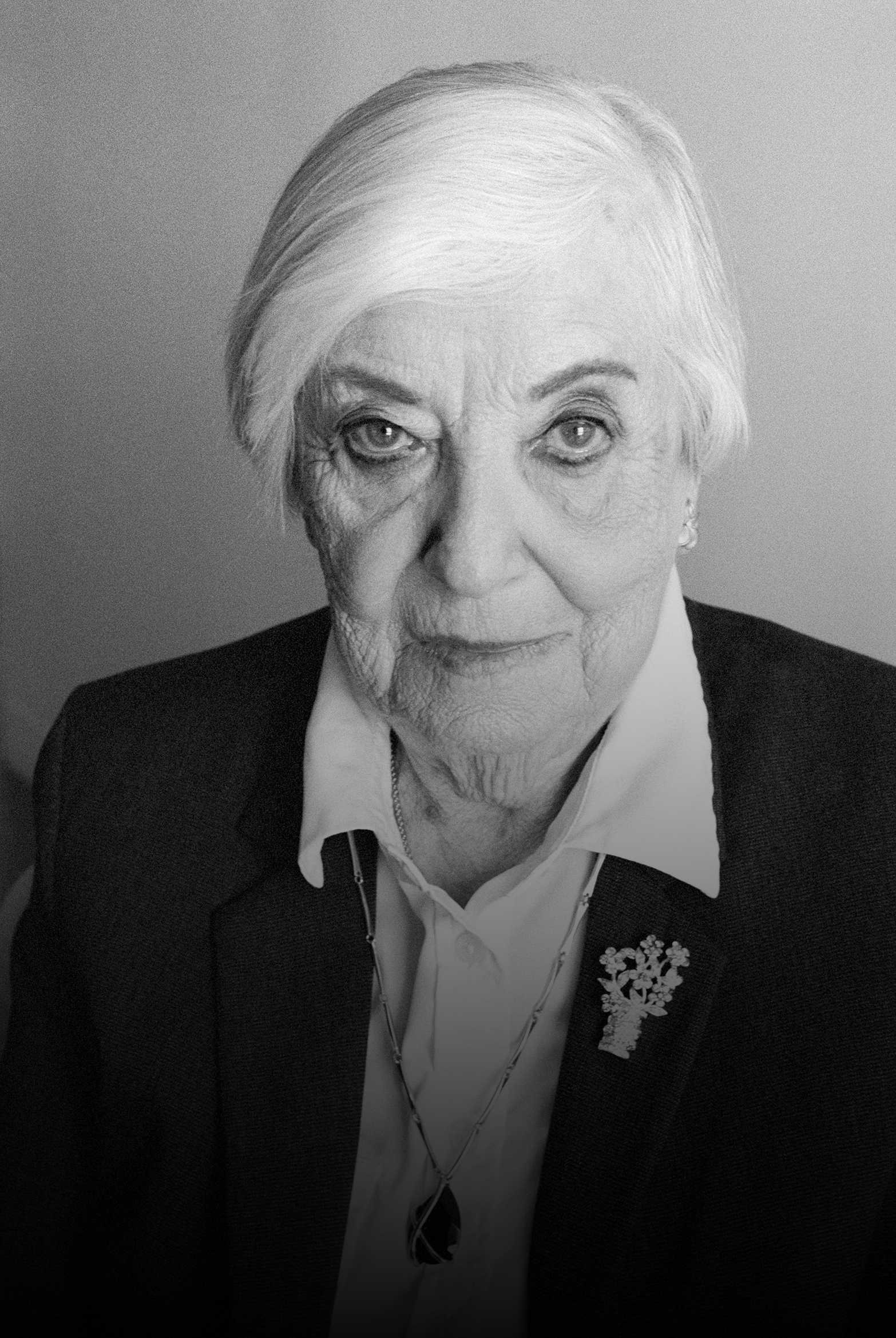
Engelina Billauer
It’s my past actually that has guided me. I think I was meant to survive to have children, grandchildren and even great-grandchildren. That’s the most important thing. But life is not easy. You have to take it the way it comes and make the best of it.
Engelina Loewenberg was born in Berlin, Germany, on July 29, 1927, to Tambe and George Loewenberg. She grew up with deaf-mute parents, one brother, and one sister. She attended public school but was soon expelled for being Jewish, so she transferred to a Jewish girls’ school. In October 1938, due to the stress of the anti-Jewish laws, her brother committed suicide On November 9-10, 1938, she witnessed Kristallnacht, “The Night of Broken Glass,” the destruction of Jewish homes, businesses, and synagogues, after which her school was closed.
On September 24, 1942, she and her family were arrested by the Gestapo and taken to a local synagogue to await deportation. Crowded among many Jewish families, Engelina and her sister, Friedel, were singled out when an SS officer called them up onto the stage to confirm their Jewish heritage. The officer questioned them because they both had blonde hair and blue eyes and did not look Jewish. However, they assured him that they were Jewish.
On September 27, 1942, Engelina, her family, and the other Jews in the synagogue were packed into a boxcar and taken to Estonia. Once there, Engelina and Friedel were separated from their parents, who were put on a bus destined for the gas chambers. Naturally, both girls followed their parents onto the bus but were immediately ordered off by a Nazi official. They never saw their parents again.
Three weeks later, Engelina and Friedel were transferred to a prison that housed ten girls in rooms with only seven beds. Their minimal diet consisted of raw fish. During their time there, they were forced to rebuild a bombed-out shipyard. Soon, Engelina and Friedel developed a strong friendship with three girls from Frankfurt, with whom they are still close with today. After a year, they were all transferred deeper into Estonia to the Erida Concentration Camp. Upon arrival, Engelina was selected by Nazi officials and separated from the group. Immediately, Friedel and her friends volunteered themselves for selection, as well. An officer switched them with five other girls, and their lives were saved from the fate of the gas chambers. While there, the girls had to shovel snow, cut trees, build railroads, dig ditches, carry heavy machinery, and lay bricks. Engelina, Friedel, and the girls worked there for six months before being sent to a new camp to build chimneys and work in the kitchen.
In 1944, the Soviet Army started closing in on Estonia. The camp was evacuated and all prisoners were transferred. When the boxcars were suddenly needed by the German military, the prisoners were deposited in an open field for three weeks, enduring continuous bombing by the Allies. Eventually, the prisoners were put on a ship and taken to Neuengamme Concentration Camp near Hamburg, Germany.
Afterwards, via ship and then train, they were sent to an ammunitions factory, where for six months they made grenades. As the war came to an end, they were transported to BergenBelsen Concentration Camp where the girls were forced to collect the dead prisoners and stack their bodies. They were finally liberated from Bergen-Belsen by the British Army on April 15, 1945.
At the time of liberation, Engelina and two of her friends had contracted typhus and were sent to a British hospital for treatment. After recovery, Engelina was offered British citizenship but rejected the offer because it did not include Friedel. Engelina, Friedel, and their three best friends all survived the war.
After the war, Friedel married fellow survivor, Nobert Wollheim. In 1946, Engelina met her future husband, Richard Billauer, and they married in Tel Aviv, Israel, on February 4, 1950. They went back to Hamburg, Germany to wait for a visa to go to the U.S. In Germany, Engelina gave birth to her first son, George. Later that year Engelina, Friedel, their husbands, and children moved to New York City, where they lived for 33 years. Friedel passed away in 1977.
Following Friedel’s death, Engelina and her husband moved to Santa Monica, California, to be closer to their sons, George and Michael, their grandchildren – Josh, Jesse, Jeremy and Jeffrey, and now to their great-grandchildren – Lexi, Sadie, and twins – Nakoa Reign and Dorian Blue.
When Richard passed away, Engelina suffered a stroke. With determination, she recovered and now lives with her son George, next door to grandson Jesse and his family. Jesse had overcome a terrible surfing accident as a young man, which left him a quadriplegic. Jesse inspires us with his perseverance and his non-profit organization, “Life Rolls On,” dedicated to improving the quality of life for people with disabilities through adaptive surfing and skating.
Engelina frequently shared her and Friedel’s story at Chapman University. Engelina recorded her testimony with the Shoah Foundation, and she became a regular Holocaust Survivor Speaker at the Museum of Tolerance in 2015. Engelina Billauer z”l * passed away on November 2, 2022. At the Museum of Tolerance, she will always be remembered for inspiring her audiences with her story of courage, resilience, and hope. May her memory be a blessing.
Z”L stands for the Hebrew words meaning “may his/her memory be a blessing.”