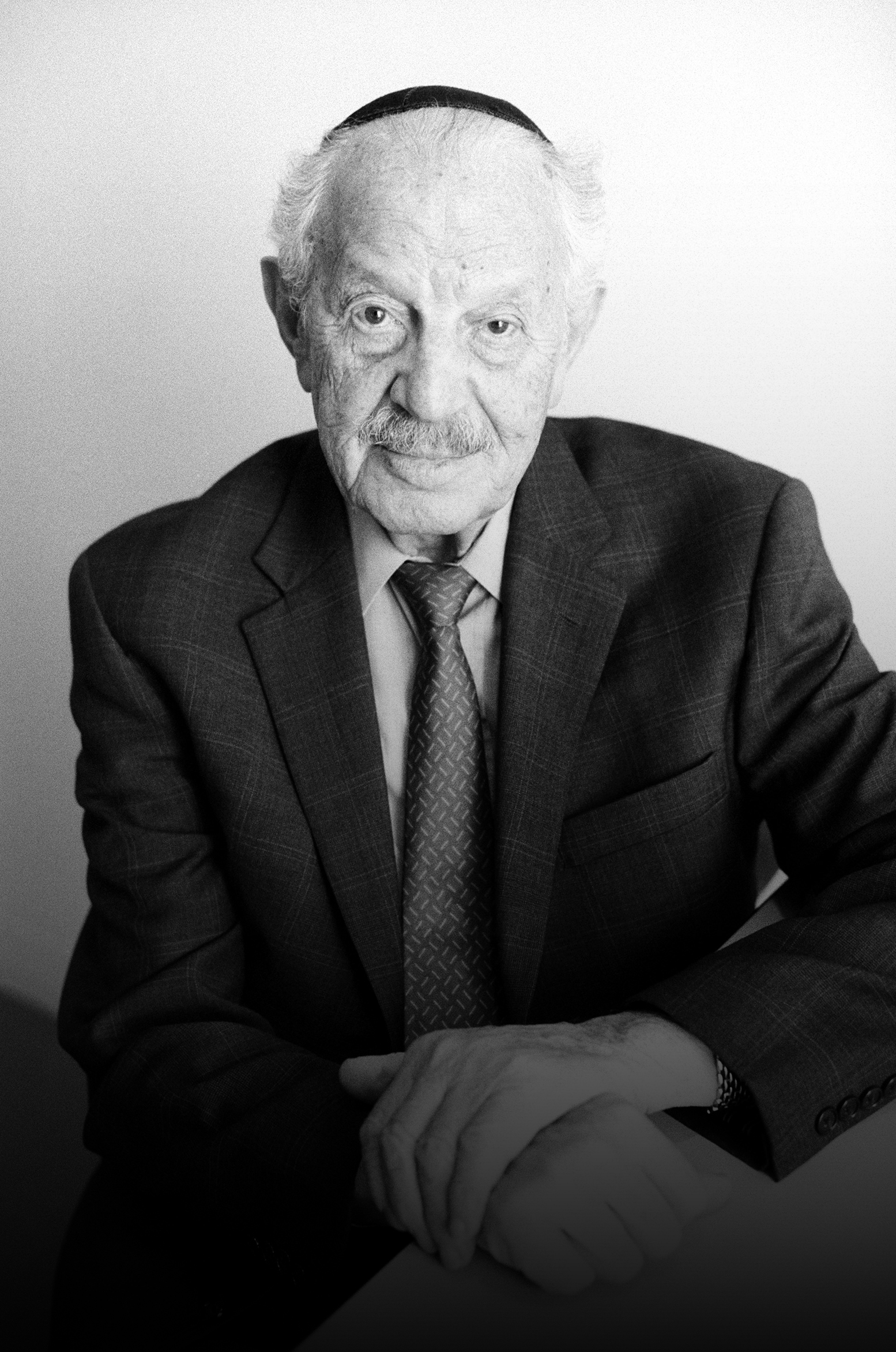
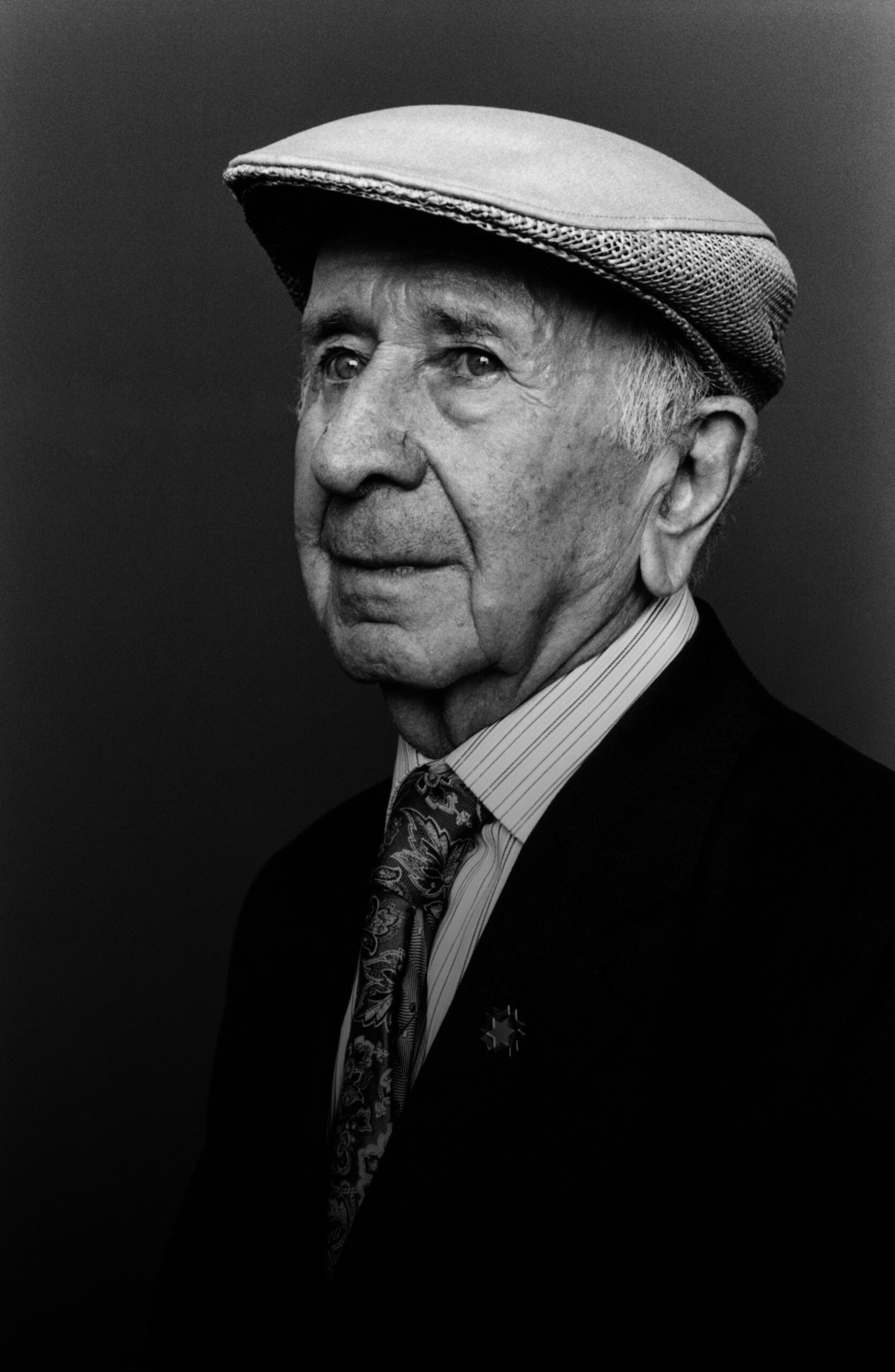
Andrew Gardner
There are two kinds of criminals: those who commit the crimes and those who watch and do nothing.
Andrew Gardner was born Endre Grünfeld on November 13, 1925, in Gyöngyös, Hungary to an Orthodox middle-class family. His father, Simon, owned a lumberyard and his mother, Margit (née Friedman), stayed at home to raise her four sons. Andrew first heard about Hitler in the early 1930’s after coming across the book Mein Kampf. However, he did not give it much thought and considered the book to be the demented ideas of a crazy man. Despite Hitler’s rise to chancellor in 1933, few people in Gyöngyös took his leadership or rantings seriously until several years later.
In Hungary anti-Jewish laws and regulations went into effect in 1939. When the Nazis occupied Hungary in 1944, Andrew and his family were forced into the Gyöngyös Ghetto in the poorest part of the city, and were forced to share small apartments with up to five families. Andrew remained in the ghetto with his family for three weeks. He and his older brothers worked in a forced labor camp, where they built roads under harsh conditions. When the Soviets started approaching Hungary, the prisoners were sent on a death march from Hungary to Mauthausen Concentration Camp in Austria. This was the last time Andrew saw his parents. On the death march, anyone who fell behind was shot and killed.
At Mauthausen, little work was productive. The Germans forced the prisoners to carry large rocks from a nearby stone quarry up and down 183 steps simply to torment them. If a prisoner dropped a rock or fell, German Shepard dogs would bite the prisoner’s jugular vein, instantly killing him. The prisoners were given insufficient food. In order to survive, Andrew ate snails, grass, and the bark of pine trees. Although Andrew was thirsty and starving, he managed to stay alive by daydreaming of being home on a Friday night for Shabbat with his family.
Andrew was forced to endure another death march to Gunskirchen-Lager Concentration Camp, a plain barracks located in the middle of a forest. American forces liberated the camp towards the end of April 1945 and began passing out food rations, which caused a stampede.
Many emaciated prisoners, unable to digest the food, died. The next morning, the ground was covered with dead bodies.
Andrew weighed only 65 pounds at liberation and suffered from typhus. After being treated in a hospital, he returned to his hometown where he remained for eight months. He reunited with his oldest brother, Erno, who had also survived Mauthausen. In 1946, Andrew moved to a displaced persons’ (DP) camp in Germany, run by the American Army. The camp had very limited resources, but Andrew was still able to attend trade school and begin working with the UN Relief and Rehabilitation Center. While at the DP Camp, Andrew met and married Martha (née Kahan), a Holocaust survivor who had survived Auschwitz.
A member of Martha’s family arranged the documentation for them to come to the United States. In 1949, Andrew and Martha left the DP camp and immigrated to the United States.
They arrived in Tulsa, Oklahoma, where Andrew began working as an assistant to a janitor.
In 1951, they moved to Los Angeles and adopted two children, Mark and Larry. In 1974, Martha passed away, but in 1975 Andrew married Yvette (née Kain).
Andrew is blessed with ten grandchildren and five great-grandchildren. He began speaking at the Museum of Tolerance after making a silent vow to himself to never forget his experience and to tell others about the horrors of the Holocaust. Andrew Gardner z”l has passed away, but his legacy lives on at the Museum of Tolerance.
Z”L stands for the Hebrew words meaning “may his/her memory be a blessing.”