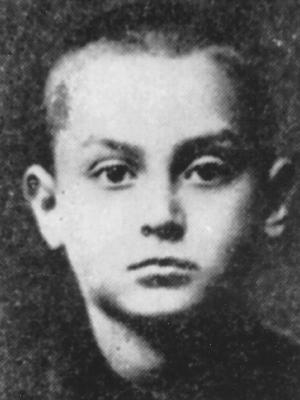
Born: December 10, 1927
Birthplace: Vilna, Lithuania
Yitskhok Rudashevski
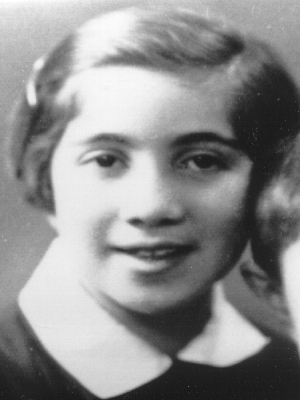
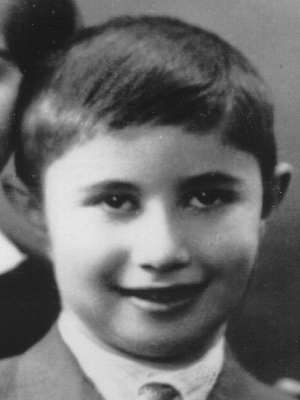
Yitskhok Rudashevski, the only child of Rose and Elihu Rudashevski, was born on December 10, 1927 in Vilna, the capital of Lithuania. Vilna had a large Jewish population and was a world center for Jewish culture and learning. In 1941, the city was home to over 80,000 Jews. Yitskhok’s father worked as a typesetter for a well-known Yiddish newspaper, and his mother was a seamstress. Part of a large, closely-knit and loving family, Yitskhok had a comfortable childhood. A good student, Yitskhok completed one year of high school at the prestigious Realgymnasium, where his favorite subjects were literature and history. He loved to read, wrote as often as he could in his diary, and went hiking and camping with his youth group.
When the Germans entered Vilna in June 1941, they were greeted by the Lithuanian people with cheers and flowers. Both the Germans and their Lithuanian collaborators immediately began persecuting Vilna’s Jews. In July, about 35,000 men, women, and children were murdered in Ponary, a wooded area about 5 miles from Vilna.
Among the victims were the leaders of the Jewish community.
In September, the remaining Jews were forced into two overcrowded, sealed-off ghettos. The smaller one was closed 46 days later, after its residents were murdered. Conditions were horrible in the remaining ghetto. There was little food, poor sanitation, and the residents were subject to random Nazi brutality and periodic roundups.
Despite these conditions, underground cultural events were organized, newspapers were published, and various social welfare groups continued functioning. Yitskhok attended a clandestine school for two years. He joined various clubs including one that collected folklore. He continued to write in his diary, describing life in the ghetto.
The destruction of Vilna’s Jews continued, as the Nazis rounded up Jews and murdered them in the Ponary forest.
A strong underground resistance group was formed, gathering weapons and planning for the defense of the ghetto. After the group was betrayed, many of its members escaped to the forest. In August 1943, as a prelude to their plan to empty the ghetto, the Nazis began sending the remaining Jews to Estonia. In September 1943, the Germans decided to murder those who were left. Yitskhok and his parents moved to a “hideout” in the attic of his uncle’s home. They hid there with his uncle’s family, along with five other people, for two weeks. In early October 1943, the Germans discovered the hideout. Yitskhok, 16 years old, and the others were taken to the forest and murdered. One of Yitskhok’s cousins managed to escape the massacre and joined the partisans in the surrounding forests. He returned to Vilna after the war and found Yitskhok’s 204-page diary.
Jewish life in Lithuania dates back to the 14th century. Lithuania’s Jews earned their living as shopkeepers, craftsmen, innkeepers and contractors. Jewish life was based on observance of tradition. Lithuania’s rabbinical schools were considered the world’s greatest. Vilna (Vilnius), the country’s capital, was one of the world’s great centers for the printing of Hebrew language books and materials. Other important centers for Jewish culture in the country were Kovno (Kaunas), Panevezys, and Telz (Telsiai). Lithuania also proved to be fertile ground for the growth of Zionism.
When Lithuania became an independent republic after World War I, its Jewish population numbered approximately 150,000.