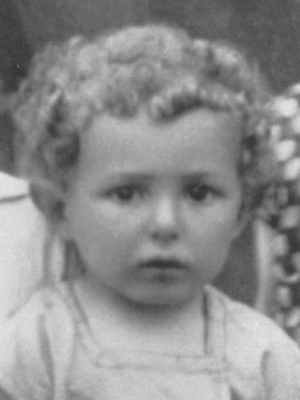
Born: April 1926
Birthplace: Pinsk, Poland
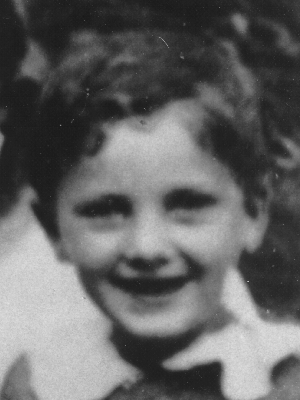
Yehiel Goldberg
Yehiel Goldberg, the son of Fayge and Yakov Goldberg, was born in April 1926 in Pinsk, Poland. He was one of six brothers and sisters. Yehiel’s father was a tailor who managed to make a basic living for his family.
Before World War II, Pinsk had a vibrant Jewish community of 30,000, 70 percent of its total population. The town was a center of Jewish religious movements. Yehiel’s father was active in a Zionist organization that supported the creation of a Jewish state where Jews would be safe.
On September 1, 1939, Germany invaded Poland, starting World War II. At that time, the Soviet Union and Germany were allies. They had agreed to divide Poland in half, each controlling one part. Pinsk was occupied by the Soviet Union, and the Jews living in Pinsk felt relatively secure, since they had little information about the rise of antisemitism under the German occupation. However, soon after the Soviet occupation, public Jewish life was discontinued, and private commerce almost ceased to exist, causing great economic hardship.
In the summer of 1941, Pinsk was occupied by the Germans, who immediately set up a “Jewish Council” to facilitate their planned murder of the entire Jewish community. One month later, the Nazis murdered 8,000 of the most prominent Jewish men of the city. A few days later, they murdered another 3,000 Jews, including the elderly and children. They were buried in mass graves a few miles from the outskirts of the city.
The Germans then began enforcing a series of repressive economic measures against the remaining Jews. They were forced into a sealed-off ghetto in a run-down part of the city. On April 30, 1942, they were given one day’s notice to vacate their apartments and to move into the designated area. They were required to leave behind all their possessions except for bedding. The ghetto was horribly overcrowded and lacked adequate food and sanitary facilities. In July 1942, all of the patients in the Jewish hospital were murdered. On October 28, 1942, almost the entire ghetto population was rounded up by the Germans and shot.
Yehiel was 15 years old when the Germans occupied Pinsk. No details are known about his fate.
Jews first came to Poland from central Europe at the end of the 11th century, as refugees from the Crusades. They were welcomed by the Polish nobility, which was eager to use their skills in modernizing their country. Jews were granted charters to live in specific towns and engage in various businesses and crafts. After the massacre of 1648-1649 by the Cossacks, Poland’s surviving Jews were impoverished.
Despite the economic poverty, however, religious and cultural life was rich. Poland was home to some of the world’s greatest rabbis and scholars. Religious observance throughout the large cities and smaller towns, known as shtetlach, was the norm, and religious scholarship was highly prized. By the late 19th and early 20th century, Jewish cultural life in Poland expanded to include political parties and Zionist groups, as well as a wide range of literature and sports clubs. By the 1930s, Poland’s Jews numbered over 3 million and accounted for 10% of the total population.