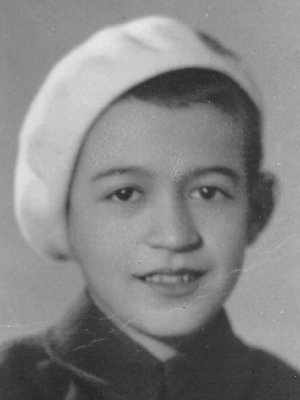
Born: December 26, 1928
Birthplace: Satu-Mare, Romania
Victor Rona
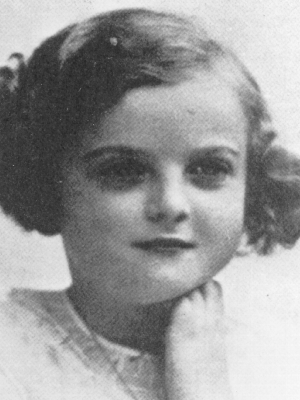
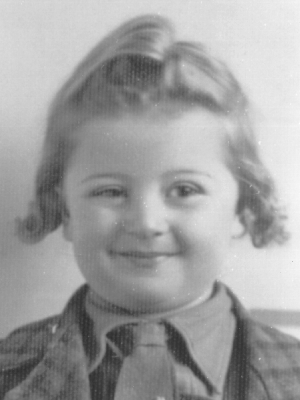
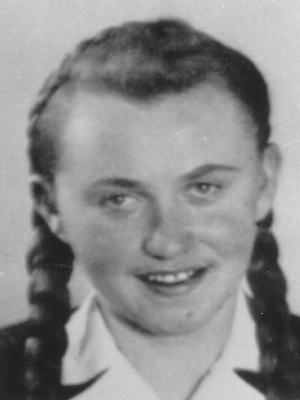
Victor Rona, the older son of Magdalena and Alexander Samuel Rona, was born December 26, 1928 in Satu-Mare, Romania. Jews comprised 20 percent of the city’s population and took an active role in the development of commerce and industry. They were found in almost all professions. Victor’s father was a professor in the State Commercial College, and his mother was active in Jewish communal activities. The family had a comfortable life.
In 1940, their lives changed when Satu-Mare was annexed to Hungary. After the annexation, Hungary, a German ally, passed anti-Jewish measures restricting Jewish economic activity and barring Jews from various professions. Victor’s father lost his job at the university and became director of the new Jewish High School, founded in 1941. As a high school student, Victor excelled in literature, music, and sports.
Despite the prevailing antisemitic attitudes, Victor won a medal in fencing competition with non-Jews.
In addition, Victor studied piano and spent hours working on his stamp collection. He was also active in several Jewish youth organizations, where he had many friends.
In March 1943, when Victor was 15 years old, Hungary tried to break its alliance with Germany. A year later, dissatisfied with Hungary’s refusal to collaborate, Hitler ordered his troops to invade Hungary.
On March 19, 1944, German troops occupied all of Hungary. The Nazis immediately initiated their plan to kill all the Jews. Assisted by Hungarian collaborators, the Germans deported local Jews to ghettos and concentration camps.
On May 30, 1944, Victor and his parents were rounded up and forced into the city’s ghetto. Soon after, they were deported to Auschwitz Death Camp in Poland. Victor’s mother was gassed immediately upon arrival.
Strong, healthy and fit for work, Victor was immediately selected for forced labor. Between June 1944 and April 1945, Victor was sent to four different labor camps in Germany. Despite the beatings, stabbing, lack of food and the spread of disease, Victor survived and was liberated in April 1945. However, five days later, Victor died from an untreated bayonet wound inflicted on him in Flossenburg Concentration Camp two weeks earlier.
It is believed that Jews first came to what is now Romania in the second century C.E. Most of Romania’s Jewish community, however, are descendants of Polish Jews who fled there to escape the Cossack massacres of 16481649. Others have their roots in the old Austro-Hungarian Empire.
Antisemitism was a major factor in Romanian society and legislation limiting the role Jews could play in the country’s civic life was a fact of life. There were quotas for Jews in the universities where antisemitic riots were not uncommon. Legislation proposing increased rights for Jews was met with rancorous debate in parliament. It was not until 1928 that the Jewish community was afforded official recognition. Most Romanian Jews earned their living as small shopkeepers and craftsmen, but others were prominent in industry, including textiles, glass manufacturing, and furniture. OF the liberal professions, only medicine was open to Jews. By 1924, approximately 750,000 Jews lived in Romania, accounting for 5% of the total population.