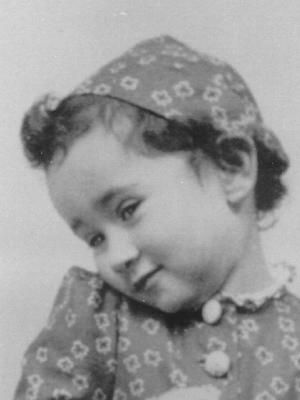
Born: April 8, 1935
Birthplace: Vienna, Austria
Toska Feuchtbaum
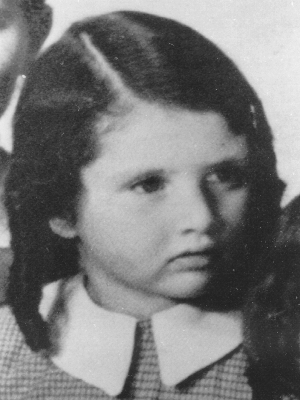
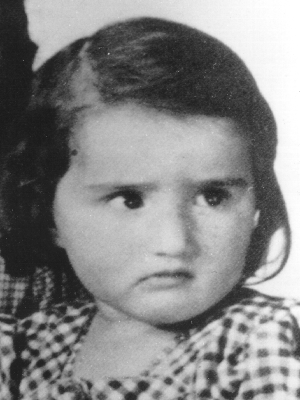
Toska Feuchtbaum, the daughter of Ryfka and Adolf Feuchtbaum, was born on April 8, 1935 in Vienna, Austria. Her father was a professional photographer, and one of his favorite subjects was Toska. Adolf was active in Jewish community life and was a member of the Jewish World War I veterans’ association.
In March 1938, Hitler annexed Austria. Soon after, Toska’s father was arrested, and he was sent to Dachau Concentration Camp. Later, he was transferred to Buchenwald and was released in 1939. He fled to France, where he later joined the French resistance.
Toska and her mother endured great suffering. Unable to leave Austria because they had no money, they were removed from their comfortable apartment and forced to live, along with all the other Jews of Vienna, in an overcrowded part of the city. Half-starved and impoverished, they feared for their lives.
On May 12, 1942, at 8:15 p.m., Toska and her mother, along with 998 other Viennese Jews, were deported to Izbica, A town in occupied Poland on the main rail line between Lublin and Belzec Death Camp. In order to make space for the incoming transports, 2,200 local Jews were sent to Belzec on March 24, 1942. Between March and June, 16 transports containing approximately 12,000 to 15,000 Jews from across Europe were sent to Izbica. The majority were women, children, and the elderly.
The new arrivals were housed in a few wooden barracks which could hold only about half of the prisoners, pressed together like sardines. The rest were forced to live outdoors. Jews stayed in the barracks usually for a maximum of four days, with almost no food or sanitation. Those who managed to survive the horrendous living conditions in Izbica were transported to death camps.
Nothing is known about Toska or her mother after they were deported to Izbica. No trace has ever been found.
Jews first came to Vienna from Germany in the 12th century. During the 19th century, Vienna became a hub for Jewish authors and intellectuals, and by 1923, the local Jewish community had grown to nearly 200,000, third largest in all of Europe. Vienna’s Jewish community maintained 60 synagogues, a vast educational network, and a variety of social action institutions. It was also in Vienna that Theodore Herzl established the first headquarters of the Zionist movement. At the same time, however, Vienna was a center of popular antisemitism. At the turn of the century, Karl Lueger was elected mayor on a platform espousing anti-Jewish views. Nevertheless, the Jewish community, among the most sophisticated throughout Europe, continued to thrive.