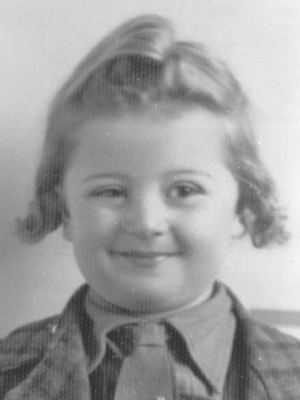
Born: February 1939
Birthplace: Satu-Mare, Romania
Tibor Roth
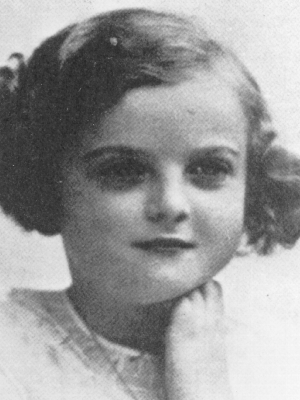
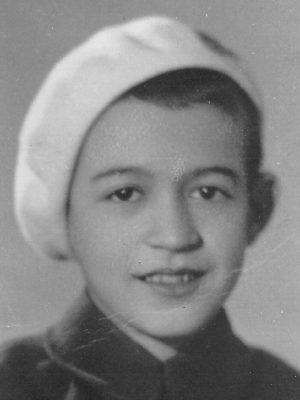
Tibor Roth, the only child of Lenke and Simon Roth, was born in February 1939 in Satu-Mare, Romania.
Tibor was born 22 years after his parents were married and his birth was greeted with great joy. Tibor was a very bright, charming little boy, adored by his parents, family and friends.
Jews in Satu-Mare comprised 20 percent of the city’s population and took an active role in the development of commerce and industry in the city. They were found in almost all professions. Tibor’s father was a wine merchant and provided his family with a comfortable life.
The Roth family’s lives changed in 1940 when Satu-Mare was annexed to Hungary. After the annexation, Hungary, a German ally, passed anti-Jewish measures restricting Jewish economic activity and barring Jews from various professions.
In March 1943, when Tibor was 4 years old, Hungary tried to break its alliance with Germany. A year later, dissatisfied with Hungary’s refusal to collaborate, Hitler ordered his troops to invade Hungary. On March 19, 1944, German troops occupied all of Hungary. The Nazis immediately initiated their plan to kill all the Jews. Assisted by Hungarian collaborators, the Germans deported local Jews to ghettos and concentration camps.
On May 30, 1944, Tibor and his parents were rounded up and forced into the city’s ghetto. Soon after, they were deported to Auschwitz Death Camp in Poland, where they were murdered immediately upon arrival.
It is believed that Jews first came to what is now Romania in the second century C.E. Most of Romania’s Jewish community, however, are descendants of Polish Jews who fled there to escape the Cossack massacres of 16481649. Others have their roots in the old Austro-Hungarian Empire.
Antisemitism was a major factor in Romanian society and legislation limiting the role Jews could play in the country’s civic life was a fact of life. There were quotas for Jews in the universities where antisemitic riots were not uncommon. Legislation proposing increased rights for Jews was met with rancorous debate in parliament. It was not until 1928 that the Jewish community was afforded official recognition. Most Romanian Jews earned their living as small shopkeepers and craftsmen, but others were prominent in industry, including textiles, glass manufacturing, and furniture. OF the liberal professions, only medicine was open to Jews. By 1924, approximately 750,000 Jews lived in Romania, accounting for 5% of the total population.