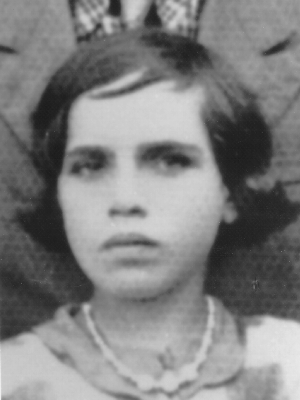
Born: 1927
Birthplace: Stawiski, Poland
Sura Andrzejko
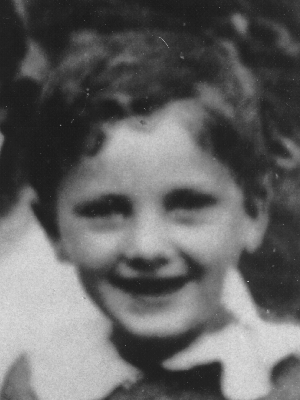
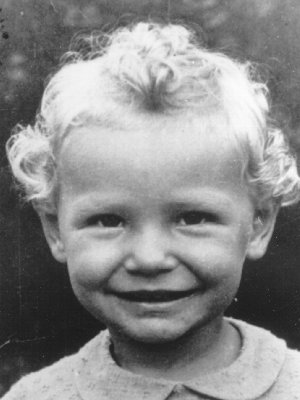
Sura Andrzejko, the youngest child of Fay and Hershel Andrzejko, was born in 1927 in Stawiski, Poland, a small rural village near Bialystok. The entire population of Stawiski was Jewish. Outside the village, the non-Jewish peasants were often hostile to the Jews.
Sura’s older brother left Stawiski in 1938 for the United States. Sura remained in the village with her grandfather, parents, and older sister.
On September 1, 1939, Germany invaded Poland, starting World War II. At that time, the Soviet Union and Germany were allies. They had agreed to divide Poland in half, each controlling one part. Stawiski was occupied by the Soviet Union, and the Jews living in Strawiski felt relatively secure, since they had little information about the rise in antisemitism under the German occupation.
In July 1941, Germany invaded Strawiski and immediately massacred most of its residents. Sura and her family were trapped.
German killing squads, called Einsatzgruppen, continued to massacre Jews in surrounding towns. The Nazis murdered more than 20,000 Jews during the first two months of the German invasion. On November 2, 1942, one of the most carefully organized and intensive roundups of the war took place.
Sura and her family were hunted down by the Germans. They were taken, along with all the remaining Jews in the surrounding villages, to a military camp.
In January 1943, the entire camp, with its 20,000 inmates, was forced into sealed cattle cars. The Jews were taken to Auschwitz Death Camp where they were murdered in the gas chambers.
Jews first came to Poland from central Europe at the end of the 11th century, as refugees from the Crusades. They were welcomed by the Polish nobility, which was eager to use their skills in modernizing their country. Jews were granted charters to live in specific towns and engage in various businesses and crafts. After the massacre of 1648-1649 by the Cossacks, Poland’s surviving Jews were impoverished.
Despite the economic poverty, however, religious and cultural life was rich. Poland was home to some of the world’s greatest rabbis and scholars. Religious observance throughout the large cities and smaller towns, known as shtetlach, was the norm, and religious scholarship was highly prized. By the late 19th and early 20th century, Jewish cultural life in Poland expanded to include political parties and Zionist groups, as well as a wide range of literature and sports clubs. By the 1930s, Poland’s Jews numbered over 3 million and accounted for 10% of the total population.