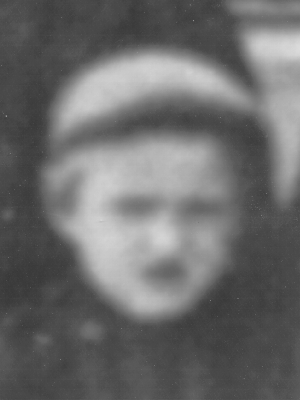
Born: 1938
Birthplace: Sighet, Romania
Shelaibi Eizikovits
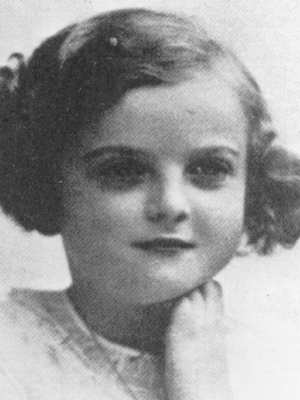
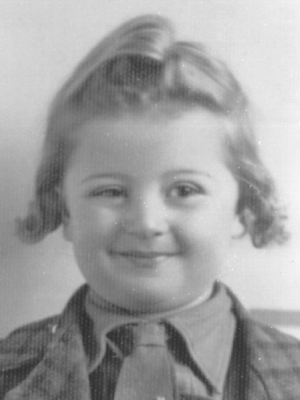
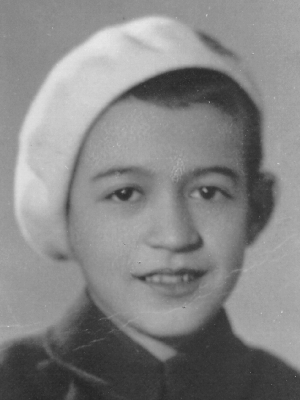
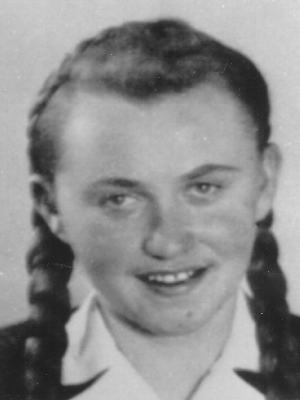
Shelaibi Eizikovits, the son of Alte and Sano Eizikovits, was born in 1938 in Sighet, Romania. Over 10,000 Jews lived in Sighet, the highest proportion of Jews of any town in the country. Sighet had a vibrant and traditional Jewish community, including Jewish schools, Zionist organizations, and Jewish newspapers and libraries. Shelaibi came from a large, religious extended family. Though most of the Jews of the region were poor, Shelaibi’s father, a real estate broker, was able to provide his family with a comfortable life.
Shelaibi was only 2 years old when Sighet was annexed by Hungary in 1940. After the annexation, Hungarian authorities restricted Jewish economic activity. In 1942, the Hungarian government, an ally of Germany, conscripted Jewish men of military age for forced labor along the Russian front lines. Over 40,000 Jews were killed. The Hungarians refused, however, to permit their deportation to German concentration camps.
In September 1943, Shelaibi began kindergarten. On March 19, 1944, the Germans invaded Hungary. Suddenly, the entire Jewish population, which had seemingly been safe from the Nazi terror, came under their control. Within a few weeks, tens of thousands of Hungarian Jews were driven from their homes in towns and villages, and forced into sealed ghettos, often located in brick factories or lumber yards.
Shelaibi and his family, along with the 12,000 Jews of his town and neighboring villages, were forced into an overcrowded, sealed-off ghetto. They had little food and poor sanitary facilities. Between May 15 and July 8, 1944, the ghetto was emptied. Shelaibi and his family were pushed by gun-wielding soldiers into horrendously overcrowded cattle cars. Those who resisted were shot. The Jews were not given food and there were no sanitary facilities on the cattle cars. Hundreds died during the journey. Others were driven insane by the horrible confinement.
When the train arrived at Auschwitz Death Camp in Poland, Shelaibi and his family were taken directly to the gas chambers and murdered.
Shelaibi was 6 years old.
It is believed that Jews first came to what is now Romania in the second century C.E. Most of Romania’s Jewish community, however, are descendants of Polish Jews who fled there to escape the Cossack massacres of 16481649. Others have their roots in the old Austro-Hungarian Empire.
Antisemitism was a major factor in Romanian society and legislation limiting the role Jews could play in the country’s civic life was a fact of life. There were quotas for Jews in the universities where antisemitic riots were not uncommon. Legislation proposing increased rights for Jews was met with rancorous debate in parliament. It was not until 1928 that the Jewish community was afforded official recognition. Most Romanian Jews earned their living as small shopkeepers and craftsmen, but others were prominent in industry, including textiles, glass manufacturing, and furniture. OF the liberal professions, only medicine was open to Jews. By 1924, approximately 750,000 Jews lived in Romania, accounting for 5% of the total population.