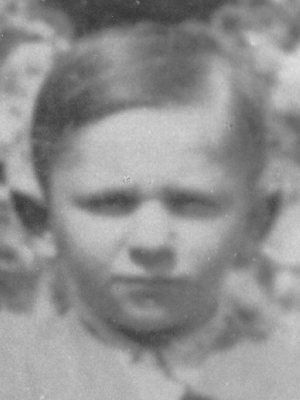
Born: 1936
Birthplace: Paris, France
Noach Szejniuk
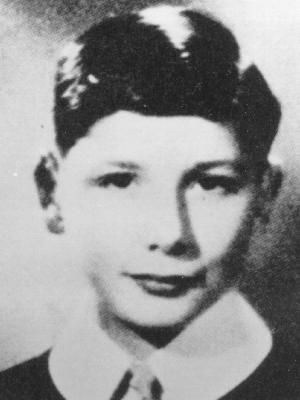
Noach Szejniuk, the only child of Fejge and Motel Szejniuk, was born in 1936, in Paris, France. Paris was a glittering, cosmopolitan city, where Jews were well integrated into social and cultural life. Feige and Motel had moved to Paris long before Noach was born to escape the oppressive antisemitism of Poland and to live in a more liberal atmosphere. Motel worked in a soda factory.
When the Nazis invaded France in June 1940, Noach was 4 years old. The Germans immediately passed harsh antisemitic measures, barring Jews from most professions and from public schools. In October 1940, the Germans and the recently formed French Vichy government initiated comprehensive “Jewish Laws.” Additional antisemitic measures were enacted, and some 6,000 Jews lost their citizenship.
In the summer of 1942, Jews were forced to wear yellow stars to identify them as Jews. Soon after, the Germans began rounding up Jews, sending them to Drancy Transit Camp for deportation to “the East.” Noach’s desperate parents found a home for him with sympathetic Christians, who were willing to risk their lives in order to hide and save him.
Noach’s mother was arrested and sent to a concentration camp near the Spanish border. Somehow she managed to escape and made her way over a treacherous route through the Pyrenees Mountains, finding refuge in Barcelona, Spain. Noach’s father was also arrested and interned in a concentration camp. He was also able to escape and made his way back to Paris. In March 1943, he was discovered hiding in a barn by the Nazis and immediately shot to death.
Paris was liberated by Allied troops in August 1943. Noach’s mother, searching for her son, retraced her steps over the Pyrenees Mountains and returned to Paris. There she found her 7-year-old son still safely living with his caring Christian guardians.
Jews have lived in France for more than 1500 years. Despite considerable persecution, which included massacres and expulsion during the Middle Ages, the community survived, in great part due to immigration of Jews from other lands in later centuries when conditions had improved.
On the eve of the French Revolution, approximately 40,000 Jews lived in France. Finding greater acceptance in society, Jews were able to take advantage of the great opportunities afforded them, and their economic position improved. The community established schools in the early 1800s and maintained a wide assortment of charitable and welfare institutions. Despite its European character, the French Jewish community was able to absorb Jewish immigrants from North Africa, where France once had colonies. By the eve of World War II, France’s Jewish population, including refugees from other parts of Europe, numbered approximately 350,000.