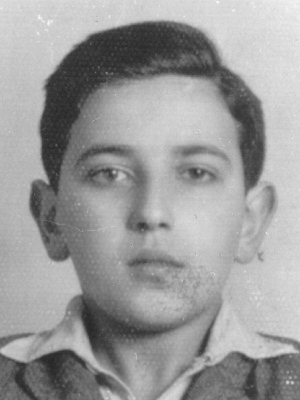
Born: 1924
Birthplace: Lodz, Poland
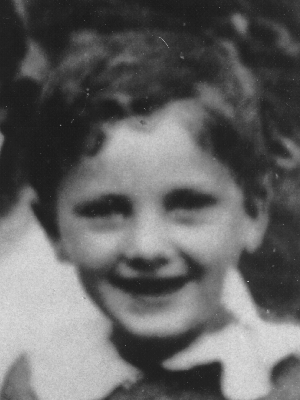
Natan Abbe
Natan Abbe, the son of Carola and Israel Abbe, was born in 1924. His father owned a haberdashery store where he sold hats, gloves, and other accessories. Natan had two sisters and a younger brother.
Natan grew up in Lodz, Poland. A large, fairly liberal city, Lodz was home to over 233,000 Jews. It was a major center of the textile industry. A diverse population of Jews, Poles and Germans lived together in relative peace.
When the Germans occupied Lodz in September 1939, Natan was a 15-year-old schoolboy. Anti-Jewish restrictions were immediately enacted. Jews were forbidden to congregate for religious services, they were subject to curfew, their radios were confiscated, and they were forced to wear yellow stars to identify them as Jews. In addition, Jews were barred from most professions, and all Jewish communal institutions were ordered to disband.
On February 8, 1940, Natan, his family and all Lodz’s Jews were forced to relocate to a run-down part of the city. On May 1, 1940, the overcrowded ghetto was closed off.
Living conditions were horrendous. There was no heat, little food or medicine, and inadequate sanitation. People fell dead in the street from starvation, disease and exposure. Still, the basic appearance of normal inner-city life was maintained. Schools and hospitals still functioned inside the ghetto.
The Germans constantly harassed the Jewish residents of the ghetto, randomly seizing people on the streets, raiding their apartments, and subjecting them to terrible indignities. People were shot at random. Young children often became the sole support of their families. They would smuggle themselves out of the ghetto in order to find food and bring it back to their starving parents, brothers and sisters.
Natan was shot to death in late 1940 by a German soldier at the ghetto gate. He was 16 years old.
Jews first came to Poland from central Europe at the end of the 11th century, as refugees from the Crusades. They were welcomed by the Polish nobility, which was eager to use their skills in modernizing their country. Jews were granted charters to live in specific towns and engage in various businesses and crafts. After the massacre of 1648-1649 by the Cossacks, Poland’s surviving Jews were impoverished.
Despite the economic poverty, however, religious and cultural life was rich. Poland was home to some of the world’s greatest rabbis and scholars. Religious observance throughout the large cities and smaller towns, known as shtetlach, was the norm, and religious scholarship was highly prized. By the late 19th and early 20th century, Jewish cultural life in Poland expanded to include political parties and Zionist groups, as well as a wide range of literature and sports clubs. By the 1930s, Poland’s Jews numbered over 3 million and accounted for 10% of the total population.