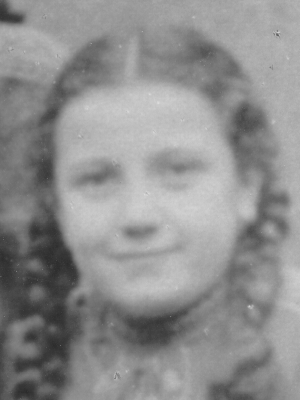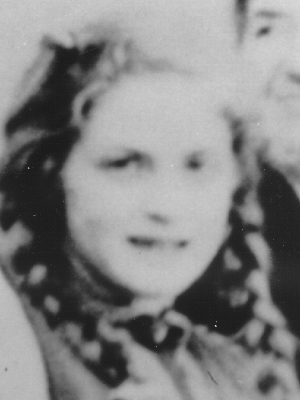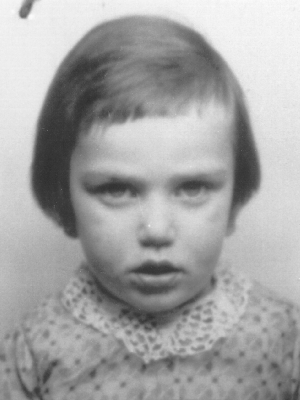

Born: February 17, 1928
Birthplace: Hellenthal, Germany
Margot Heuman
Margot Heuman, the older daughter of Johanna and Carl Heuman, was born on February 17, 1928, in Hellenthal, Germany. She grew up in Bielefeld, Germany. Her father was a successful businessman, while her mother stayed home with the children. When Hitler came to power in 1933, Margot was 5 years old. The Germans quickly introduced antisemitic legislation, making life difficult for most Jews. Many left the country, but others believed that the situation was only temporary. The Jews of Germany felt a strong connection with Germany and with German culture, and could not imagine that the Nazis would manage to stay in power for any length of time. Many did not want to leave elderly relatives who could not be easily uprooted.
In 1935, Germany enacted the Nuremberg Laws, revoked the citizenship of all German Jews. Jews were soon barred from most professions and from public education. They were forced to sell their businesses and were segregated from the non-Jewish population. Many became impoverished.
On the night of November 9-10, 1938, countrywide acts of terror and destruction were carried out against Germany’s Jews. These events became known as Kristallnacht, “Night of Broken Glass,” because of all the glass windows that had been broken. Most Jews now realized that their lives were in danger, but those who wished to leave Germany found that there were very few countries that would let them in. In 1941, Jews were forbidden to emigrate. Margot and her family were now trapped.
Early in 1942, Margot and her family were arrested and sent to Theresienstadt Ghetto in Czechoslovakia. Margot and her sister lived in a children’s home. They saw their parents every day after work. The camp was overcrowded and unsanitary, and the food was minimal. Many died of hunger and disease. There were also frequent deportations of people who were sent to death camps in “the East.” In May 1943, 15-year-old Margot and her family were transported to Auschwitz Concentration Camp. Margot was sent to the women’s barracks, where she worked as a slave laborer and endured overwhelming hardships.
Nothing further is known about her fate.
Jewish life in Germany dates back to the days of the Roman Europe. As with the rest of Europe during the Middle Ages, the rights of Jews in Germany were greatly limited due to the influence of the church. In the late 18th and early 19th century, the situation changed and Jews found greater acceptance in German society. Most German Jews quickly assimilated into the environment around them. Many became prominent musicians, writers, teachers, scientists, politicians and businessmen. Antisemitism, though still a factor in German society, was not as prevalent as in Eastern Europe. As a result, German Jews were fiercely patriotic and fully identified with their country’s hopes and dreams.