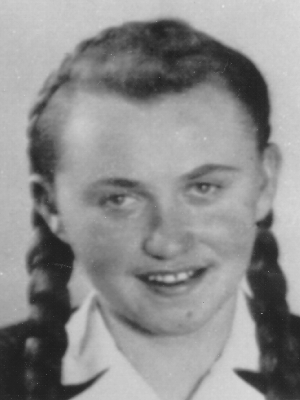
Born: June 7, 1927
Birthplace: Cluj, Romania
Magda Mozes
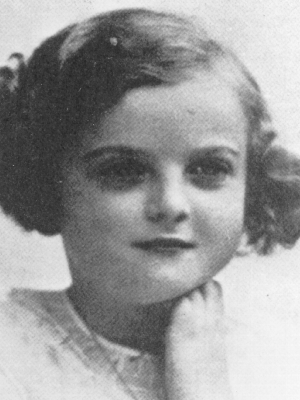
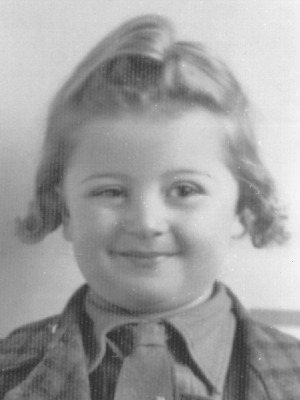
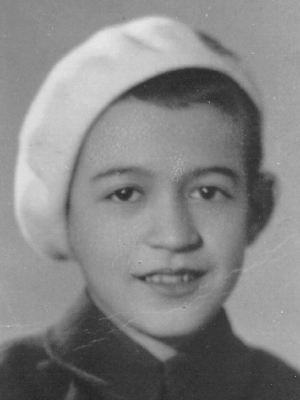
Magda Mozes, the only child of Bertha and Gus Mozes, was born on June 7, 1927, in Cluj, Romania. Cluj is located in the legendary region of Eastern Europe known as Transylvania. The Jewish community, with 16,000 Jews, was one of the largest in the province. Cluj had a well-developed network of educational, cultural, and charitable institutions and many politically active Zionist leaders. Before the Nazi occupation, the Jewish Party even had a representative in the Romanian Parliament.
In 1940, Hungary took over Transylvania, and Cluj’s name was changed to Kolozsvar. Nonetheless, Magda and her family continued to feel safe. As an ally of Nazi Germany, Hungary was not invaded, but the Hungarian government was urged by the Germans to deport its Jews to concentration camps.
The Hungarian government was not willing to send its Jewish citizens to their deaths. However, they passed harsh laws restricting Jews from economic activities. Despite the restrictions, Magda was able to continue her studies at the local Jewish high school until graduation.
In 1943, when Hungary tried to break its alliance with Germany, Hitler ordered his army to invade Hungary.
On March 19, 1944, German troops occupied the entire country. With the aid of Hungarian collaborators, the Germans began deporting local Jews to concentration camps. Magda and her family were rounded up and forced into a brickyard where they were kept for three weeks.
On June 6, 1944, Magda and the entire Jewish population of Cluj and the surrounding area were transported to Auschwitz Concentration Camp in Poland.
Magda, a strong, healthy 17 year old, was not sent to the gas chambers but was put to work as a slave laborer. When Magda tried to stay with her mother, camp guards beat her, breaking her collarbone and shoulder. However, she was still forced to work on a rock pile. Toward the end of the war, as the Germans were forced to retreat from Eastern Europe, Magda and others were transported to labor camps in Germany.
Magda was liberated on her 18th birthday. On August 26, 1945, she returned to her hometown of Cluj.
There was no trace of her family, and she no longer had a home to return to.
Magda came to the United States in 1947, married, and lived to have grandchildren. Magda was a volunteer at the Museum of Tolerance, where she shared her personal Holocaust testimony.
It is believed that Jews first came to what is now Romania in the second century C.E. Most of Romania’s Jewish community, however, are descendants of Polish Jews who fled there to escape the Cossack massacres of 16481649. Others have their roots in the old Austro-Hungarian Empire.
Antisemitism was a major factor in Romanian society and legislation limiting the role Jews could play in the country’s civic life was a fact of life. There were quotas for Jews in the universities where antisemitic riots were not uncommon. Legislation proposing increased rights for Jews was met with rancorous debate in parliament. It was not until 1928 that the Jewish community was afforded official recognition. Most Romanian Jews earned their living as small shopkeepers and craftsmen, but others were prominent in industry, including textiles, glass manufacturing, and furniture. OF the liberal professions, only medicine was open to Jews. By 1924, approximately 750,000 Jews lived in Romania, accounting for 5% of the total population.