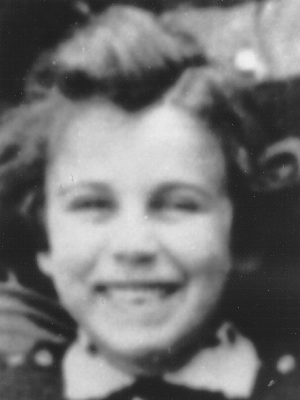
Born: August 26, 1938
Birthplace: Amsterdam, the Netherlands
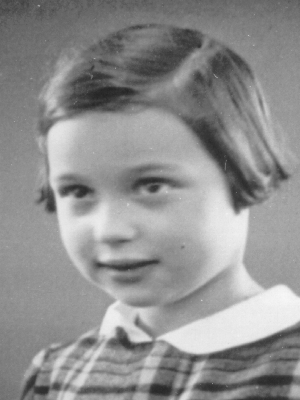
Lore Baer
Lore Baer, the daughter of Edith Sophie and Ernst Leo Baer, was born in Amsterdam, the Netherlands, on August 26, 1938. Lore’s father worked in the steel industry, and her mother was a milliner. The family lived in Amsterdam, a large, cosmopolitan city. The Jews of Amsterdam were well integrated into the city’s social, cultural and economic life.
When the Germans occupied the Netherlands, Lore was not yet 2 years old. They immediately took steps to separate the Jews from the rest of the population. Beginning in October 1940, they liquidated Jewish businesses and banned Jews from most professions. Even the rich became poor, and most of the working class could barely survive. At first, the Dutch population resisted the anti-Jewish measures passed by the Germans, but the Germans reacted brutally, and were able to break up most organized resistance.
By July 1941, many Jews were forced into restricted ghetto areas. After May 1942, all Jews were forced to wear yellow stars to identify them as Jews. Radios were taken away, as well as bicycles. Jews were not allowed in parks and were only permitted to be on the streets during certain restricted hours.
Beginning in mid-July 1942, the Germans began rounding up the Jews of the Netherlands. They were first taken to transit camps, and from there to concentration camps in “the East.” Lore’s parents searched for a hiding place. They decided that 4-year-old Lore would be safer separated from them.
She would have a better chance passing as a non-Jew than they would. They found a family in a small town willing to risk death to save their child. Lore lived with this family for three years.
Lore’s parents found refuge with a family in another small town. After the war, they were reunited with Lore, now 7 years old.
Although a Jewish presence in the Netherlands can be documented from the 12th century, the country’s modern Jewish community actually dates back to the 1600s. At that time, Spanish and Portuguese Marranos, or Conversos (Jews who converted to Catholicism to escape the Inquisition, but secretly practiced Judaism) found a haven in the Netherlands. They were later joined by Jews from central and eastern Europe, who quickly outnumbered them. The comparatively liberal atmosphere of the Netherlands afforded increased opportunities to the Dutch Jewish community. Jews were heavily represented in various industries including the diamond trade and textile manufacturing. Many also achieved prominence in medicine and law. A Jew, Lodewijk Visser, rose to become Chief Justice of the Netherland’s Supreme Court shortly before World War II. With increased social acceptance, however, came increased assimilation. While there was always an Orthodox presence in the country, most of Holland’s Jewish community was only moderately observant of Jewish tradition, and intermarriage was common.
On the eve of World War II, more than 125,000 Jews lived in the Netherlands.