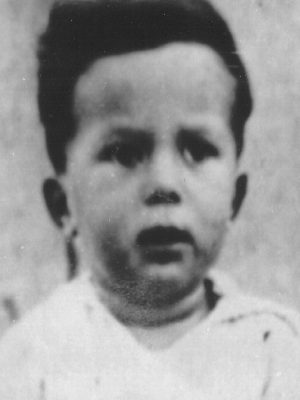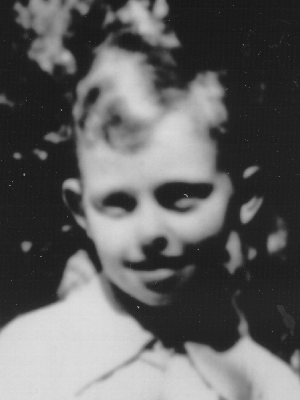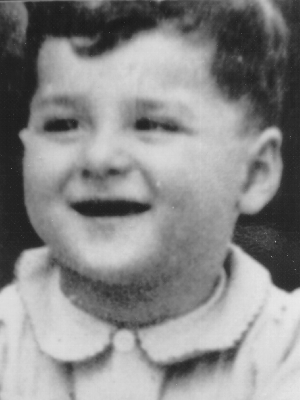
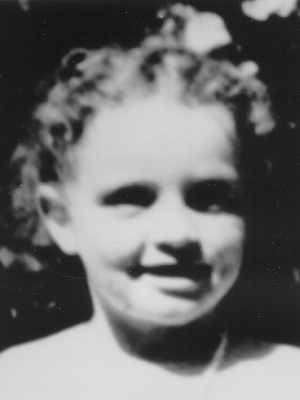
Born: November 25, 1934
Birthplace: Parma, Italy
Liliana Fano
Liliana Fano, the youngest child of Giorgina and Ermanno Fano, was born on November 25, 1934 in Pellegrino Parmense, a small village near Parma, in northern Italy. Liliana’s father worked as a pharmacist and provided a comfortable living for his family.
Jews had lived in Parma since the middle of the 14th century, but when Liliana was growing up, only 232 Jews made their homes there. The Jews of Italy were fully integrated into Italian society and culture and held positions in most professions, including the government and the military.
In November 1938, anti-Jewish racial laws were passed by the Italian government under Mussolini. Jews were forced out of most professions and barred from public education, causing financial disaster for many.
The Germans occupied Italy on September 8, 1943, and began arresting and deporting the Jews of Italy to concentration camps in “the East.” In October 1943, they raided Jewish communities in the larger cities.
Many Jews fled from their homes, looking for refuge. Liliana and her family remained in Parma.
On December 8, 1943, Liliana and her family were arrested. At first, Italian police imprisoned them in local internment camps. After four months, they were sent to Fossoli, a large internment camp run by the Germans. Men and women were separated and lived in large, unsanitary, overcrowded barracks. Food was minimal.
On April 5, 1944, Liliana and her family were forced into cattle cars, together with 850 other Jews from the camp. Conditions barely sustained life. Five days later, the trains were unsealed upon their arrival at Auschwitz Death Camp. Liliana and her family were immediately taken to the gas chambers where they were murdered.
Though more than 2,000 years old, Italy’s Jewish community was never particularly large. Despite periods of persecution by the church, Italian Jews rarely suffered the antisemitism that was part of daily life in most other parts of Europe.
By the 19th century, the vast majority of Italians accepted Jews as equals. This turned out to be a major factor in the survival of most of the country’s Jews during the Holocaust. By 1930, Italy’s Jewish population numbered just under 50,000, with the largest concentrations in Rome, Milan, Turin and Trieste. Italy’s Jews were civic-minded and extremely patriotic.