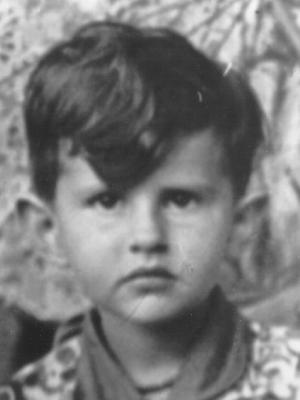
Born: 1928
Birthplace: Lvov, Poland
Lia Borak
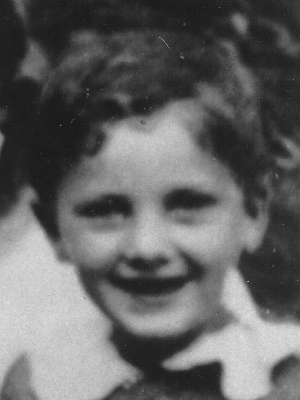
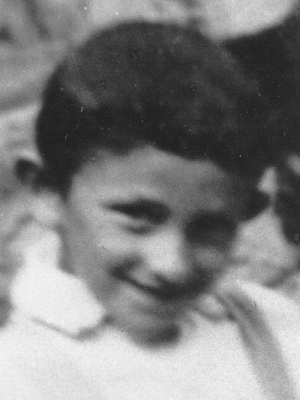
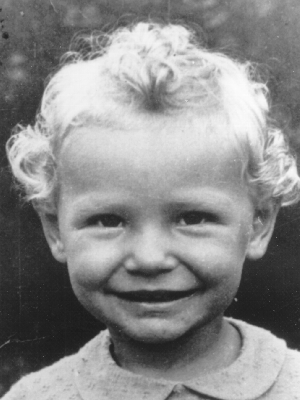
Lia Borak and her twin sister, Mia, daughters of Evelina and Adolf Borak, were born in 1928. They lived in the city of Lvov, in eastern Poland. Their father was a very wealthy landowner who lost much of his money before the war. The family was still well off, however, and they lived in a comfortable villa in a suburb of the city. The two girls were always dressed in pretty clothes and had many toys and dolls. They were fraternal twins and could be easily told apart because Mia wore glasses and had lighter hair.
Lvov had a thriving Jewish community in 1939. It was home to a Jewish population of 110,000 and was a center of culture, education and political activity. The Germans occupied Lvov on June 30, 1941, and immediately began murdering Jews. During four days of horrible antisemitic rioting, over 4,000 Jews were killed. Soon after, all Jews age 14 and above were forced to wear yellow stars to identify them as Jews. Over the next few months, Jewish property was plundered, Jews were sent to forced labor camps, synagogues were burned down, and Jewish cemeteries were desecrated.
In December 1941, the Germans forced the Jews of Lvov into a closed-off ghetto. During the move, over 5,000 elderly and sick Jews were murdered. Conditions in the ghetto were horrendous. There was terrible overcrowding and little food or sanitation. That winter, the Germans began sending Jews to labor camps, where they were worked to death.
After March 1942, the Germans began rounding up Jews and sending them to Belzec Death Camp. Only Jews working in factories that performed essential functions for the German military were to be spared.
In January 1943, the ghetto officially became a labor camp. Now, the Germans began murdering Jews at their places of work.
On June 1, 1943, a final roundup of the Jews in the ghetto began. German and Ukrainian police units surrounded the ghetto, blocking all exits. Other units were sent into the ghetto to capture the remaining inhabitants. When they met resistance, the Germans blew up buildings or set them afire. The 7,000 Jews they forced out of hiding were immediately shot.
Lia was 12 years old when the Germans occupied Lvov. No details are known about her fate.
Jews first came to Poland from central Europe at the end of the 11th century, as refugees from the Crusades. They were welcomed by the Polish nobility, which was eager to use their skills in modernizing their country. Jews were granted charters to live in specific towns and engage in various businesses and crafts. After the massacre of 1648-1649 by the Cossacks, Poland’s surviving Jews were impoverished.
Despite the economic poverty, however, religious and cultural life was rich. Poland was home to some of the world’s greatest rabbis and scholars. Religious observance throughout the large cities and smaller towns, known as shtetlach, was the norm, and religious scholarship was highly prized. By the late 19th and early 20th century, Jewish cultural life in Poland expanded to include political parties and Zionist groups, as well as a wide range of literature and sports clubs. By the 1930s, Poland’s Jews numbered over 3 million and accounted for 10% of the total population.