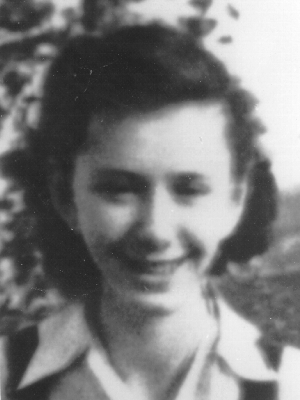
Born: December 1929
Birthplace: Užhorod, Czechoslovakia
Klara Weinfeld
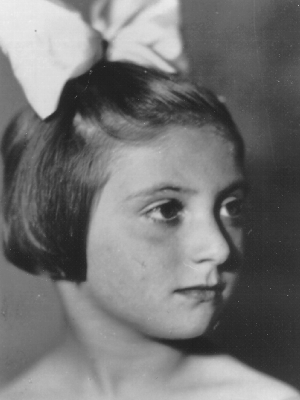
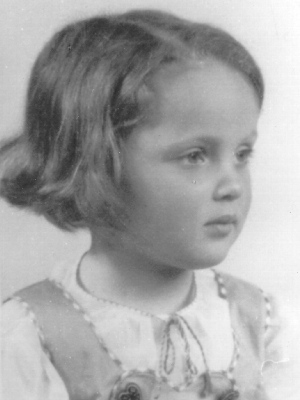
Klara Weinfeld, the youngest child of Johanna and Morris Weinfeld, was born in December, 1929, in Užhorod, Czechoslovakia. Though a small city, Užhorod was the capital of the Carpathian-Ukrainian region. It was also a cultural center and hosted regional theater groups. Nearly 7,500 Jews lived in Užhorod and more lived in the surrounding villages. Klara’s father owned menswear and textile factories. Her mother stayed home to raise her three children. The family lived in a lovely villa just outside of town. Klara, her brother and her sister attended public schools, and spent their free time with friends, skiing and sledding in the winter, and swimming and playing tennis in the summer.
In 1938, when Klara was a 9-year-old schoolgirl, Užhorod was annexed by Hungary. Hungary, an ally of Nazi Germany, immediately enacted anti-Jewish legislation. Life became difficult for Klara and her family. When her brother graduated from high school, he was conscripted for forced labor because he was Jewish. Realizing by 1944 that Germany would lose the war, Hungary tried to break its alliance with the Nazis. In March 1944, Germany invaded the country. Suddenly, the entire Jewish population, which had seemingly been safe from the Nazi terror, came under direct German control. Klara and her family were taken from their home on Passover eve, leaving all their possessions behind. Along with 25,000 other Jews from Užhorod and its surrounding areas, they were forced to live in a sealed-off brick factory on the outskirts of town. Three weeks later, Klara and her family were packed into an overcrowded cattle car and deported to Auschwitz Concentration Camp.
Upon arrival, Klara’s mother was immediately taken away and murdered. Klara and her older sister, Renée, were sent to a holding area. Klara and Renée were stripped of their clothes, and their heads were shaved. Klara cried constantly and refused to eat, even though she was starving. The sisters shared a bunk and slept with their arms around each other. There were daily selections for the gas chambers, and Renée tried to force Klara to eat so that she would keep up her strength and be assigned to a work detail. In September 1944, the sisters were separated.
Renée was chosen for work and sent to the main camp. Over the next four weeks, Renée and Klara would meet before roll call near the fence that separated their camps. One morning Klara did not show up. She had been selected and taken to a clinic where Nazis conducted medical experiments on women and children. Once they were finished with her, they shot her.
Jews first came to the former Czechoslovakia in the 10th century. Though subjected to persecution and massacres, the community survived to become the home of many famous rabbis and a rich Jewish culture. Most of Czechoslovakia’s Jews were living in Prague by the 1700s. Others lived in small towns earning their living as traders, smiths, and craftsmen.
After World War I, Jews played a major role in the economic life of the country, most notably in textiles, food stuffs, wood and paper, mining and banking. They were also major contributors to their country’s cultural life, which included such figures as Franz Kafka and Max Brod. By the 1930s the Jewish community numbered approximately 375,000.