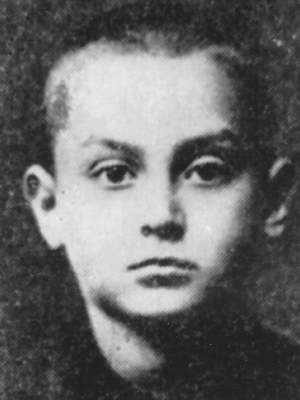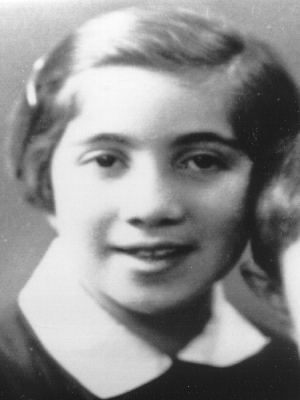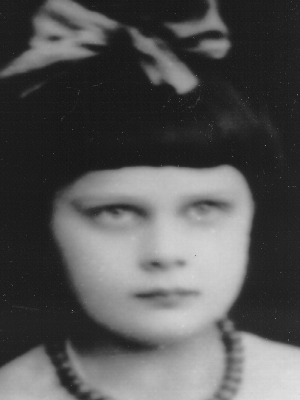

Born: 1933
Birthplace: Vilna, Lithuania
Joshua Salman
Joshua Salman, the older son of Fejgele and Szleime Salman, was born in 1933 and lived in Vilna, Lithuania.
Joshua’s parents were both teachers. Joshua was called Iske by his family and friends. His grandfather had been a rabbi and cantor, and his mother had attended university.
Vilna had a large Jewish population, and was famous worldwide as a major Jewish cultural center. In 1941, over 80,000 Jews lived in the city.
When the Germans entered Vilna in June 1941, they were greeted by the Lithuanian people with cheers and flowers. Both the Germans and their Lithuanian collaborators immediately began persecuting Vilna’s Jews. About 35,000 Jewish men, women and children were murdered in July, in a wooded area about five miles from Vilna, called Ponary. Among the victims were the leaders of the Jewish community.
On September 6, 1941, the remaining Jews were forced into two sealed-off ghettos. Conditions were horrible. There was little food and terrible overcrowding. Three months later, Joshua, his little brother, and their mother, along with other Jews, were arrested and thrown into jail. They were kept there for three days without food or water. From there they were taken to Ponary where they, too, were murdered by special German mobile killing squads called Einsatzgruppen .
Jewish life in Lithuania dates back to the 14th century. Lithuania’s Jews earned their living as shopkeepers, craftsmen, innkeepers and contractors. Jewish life was based on observance of tradition. Lithuania’s rabbinical schools were considered the world’s greatest. Vilna (Vilnius), the country’s capital, was one of the world’s great centers for the printing of Hebrew language books and materials. Other important centers for Jewish culture in the country were Kovno (Kaunas), Panevezys, and Telz (Telsiai). Lithuania also proved to be fertile ground for the growth of Zionism.
When Lithuania became an independent republic after World War I, its Jewish population numbered approximately 150,000.