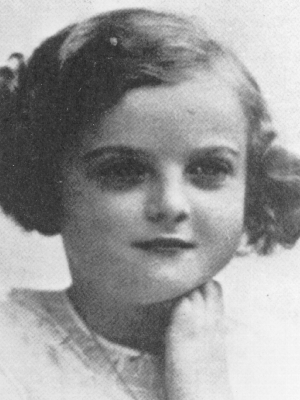
Born: 1932
Birthplace: Czernowitz, Romania
Jacqueline Morgenstern
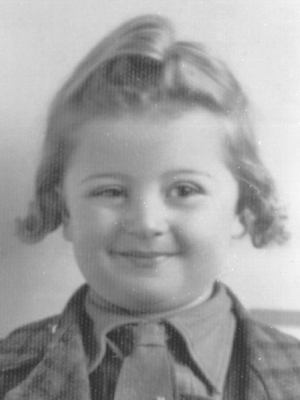
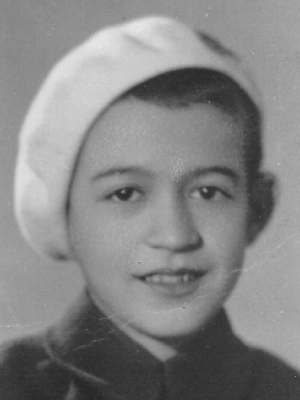
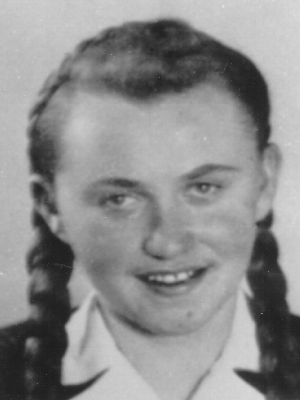
Jacqueline Morgenstern, the daughter of Suzanne and Karl Morgenstern, was born in 1932 in Czernowitz, Romania.
When she was still a tiny child, Jacqueline’s family moved to Paris to escape the oppressive antisemitism of Romania and live in a more liberal atmosphere. Paris was a glittering, cosmopolitan city, where Jews were well integrated into social and cultural life. Jacqueline’s father and uncle owned a beauty shop in the center of the city.
When the Germans occupied France in June, 1940, Jacqueline was an 8-year-old schoolgirl. The Germans immediately passed harsh antisemitic measures, barring Jews from public schools and from most professions.
Her parents were forced to give their beauty shop to a non-Jewish Frenchman.
Jacqueline and her parents fled to Marseilles, a city in southern France controlled by the Vichy government, which was collaborating with the Nazis. They carried forged papers identifying them as non-Jews. They were discovered, however, and denounced to the Germans.
On June 20, 1944, Jacqueline’s family was deported to Auschwitz Concentration Camp. For the time being, Jacqueline and her parents were spared. Jacqueline and her mother were sent to the women’s camp. Jacqueline’s mother became weak because she gave most of her food to her daughter. After she fell ill, her mother was murdered in the gas chamber.
Upon her mother’s death, Jacqueline was sent to a special children’s barrack. The 20 children in the barrack were held to be used in medical experiments. The barrack was heated and the children were provided with decent food. The staff sang songs to the children, taught them games and distracted them from the horrible smells of the crematoria. Most of the children spoke only Polish, but Jacqueline found one child who spoke French, and they became close friends.
In the fall of 1944, Dr. Kurt Heissmeyer, the doctor who had requested the children for experimentation, had them transferred to Neuengamme Concentration Camp. Jacqueline and the rest of the children were injected with tuberculosis cultures. Shortly before the end of December, they became extremely ill. In January 1945, Dr.
Heissmeyer decided to operate on the children. He wanted to find out how their glands had reacted to the TB infection.
On April 20, 1945, when the British were less than three miles from the camp, all 20 children were brought to a school in Hamburg. They were injected with morphine and fell asleep. Jacqueline and her friends were then hanged one by one.
It is believed that Jews first came to what is now Romania in the second century C.E. Most of Romania’s Jewish community, however, are descendants of Polish Jews who fled there to escape the Cossack massacres of 16481649. Others have their roots in the old Austro-Hungarian Empire.
Antisemitism was a major factor in Romanian society and legislation limiting the role Jews could play in the country’s civic life was a fact of life. There were quotas for Jews in the universities where antisemitic riots were not uncommon. Legislation proposing increased rights for Jews was met with rancorous debate in parliament. It was not until 1928 that the Jewish community was afforded official recognition. Most Romanian Jews earned their living as small shopkeepers and craftsmen, but others were prominent in industry, including textiles, glass manufacturing, and furniture. OF the liberal professions, only medicine was open to Jews. By 1924, approximately 750,000 Jews lived in Romania, accounting for 5% of the total population.