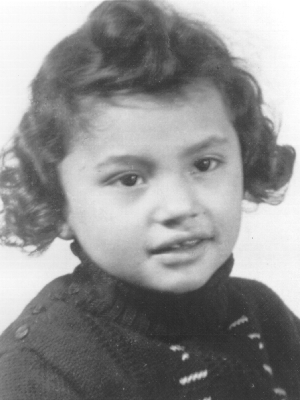
Born: December 31, 1934
Birthplace: Kippenheim, Germany
Inge Auerbacher
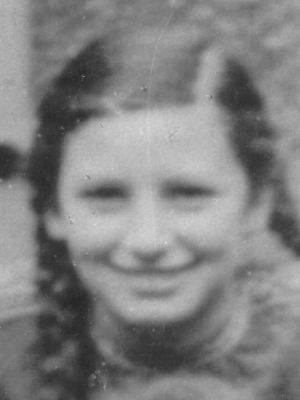
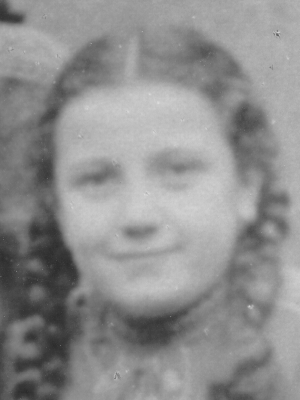
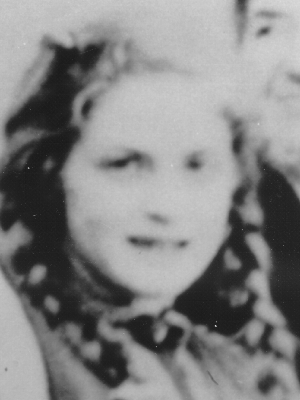
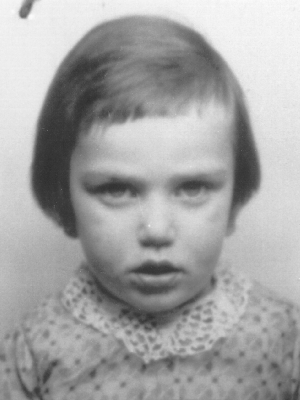
Inge Auerbacher, the only child of Regina and Berthold Auerbacher, was born on December 31, 1934 in Kippenheim, a small village in southern Germany. Inge’s father had served in the German army in WWII, and had received the Iron Cross medal for bravery. He owned a textile business in Kippenheim.
On the night of November 9-10, 1938, just before Inge’s fourth birthday, countrywide acts of terror and destruction were carried out against Germany’s Jews. These events became known as Kristallnacht , “Night of Broken Glass,” beacuse of all the glass windows that had been broken. Inge’s father was arrested and sent to a concentration camp. After his release a few weeks later, the family realized that they needed to leave the country, but they had nowhere to go.
Anti-Jewish restrictions were soon imposed, and life became increasingly difficult. A former servant provided Inge’s family with food. Inge could no longer attend the local public school, so 6-year-old Inge had to walk two miles to a larger town in order to catch a train to attend a Jewish school in Stuttgart. In 1941, she was forced to wear a yellow star, identifying her as a Jew, and she was taunted by the other children on the train.
In late 1941, Inge, her parents, and her grandmother were told to report for “resettlement.” Her father, a disabled World War I veteran, obtained a postponement, but her grandmother was sent to Latvia where she was murdered.
On August 22, 1942, Inge and her parents were arrested and deported. Forced to leave all their possessions behind, they were sent to Theresienstadt Ghetto in Czechoslovakia. Inge and her parents were sent to the disabled war veterans’ section of the ghetto where they were allowed to stay together. Conditions were horrendous. Food was scarce, sanitation was poor, and heating was inadequate. The ghetto was infested with disease-carrying vermin. Always hungry, Inge and her parents constantly lived with the fear that they would be deported to the death camps in Poland. In the spring of 1945, the Germans began building gas chambers in Theresienstadt, where they planned to kill all the remaining Jews.
On May 8, 1945, Soviet troops entered the ghetto and 10-year-old Inge and her parents were freed. Of the 15,000 children who had been imprisoned at Theresienstadt, only 125 survived.
Jewish life in Germany dates back to the days of the Roman Europe. As with the rest of Europe during the Middle Ages, the rights of Jews in Germany were greatly limited due to the influence of the church. In the late 18th and early 19th century, the situation changed and Jews found greater acceptance in German society. Most German Jews quickly assimilated into the environment around them. Many became prominent musicians, writers, teachers, scientists, politicians and businessmen. Antisemitism, though still a factor in German society, was not as prevalent as in Eastern Europe. As a result, German Jews were fiercely patriotic and fully identified with their country’s hopes and dreams.