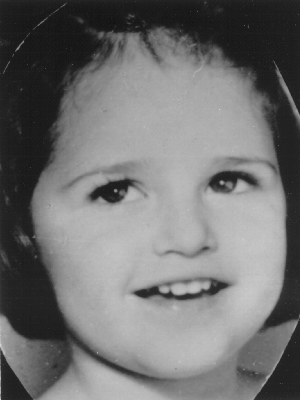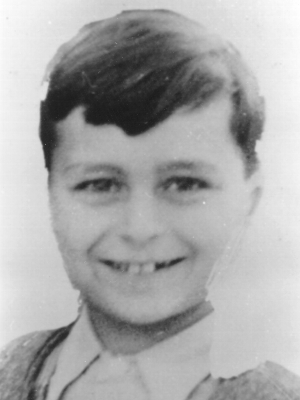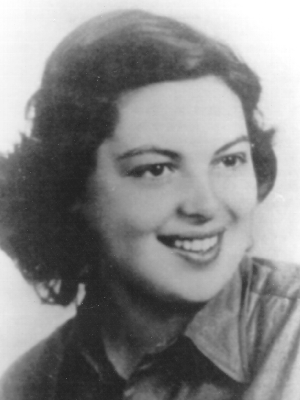
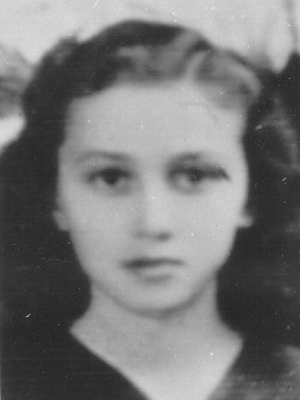
Born: January 2, 1931
Birthplace: Kisvarda, Hungary
Helen (Potyo) Katz
Helen Katz, known to her family as Potyo, was the youngest child of Teresa and Meinhart Katz. She was born on January 2, 1931 in Kisvarda, Hungary. Though her town was small, it hosted many cultural events, such as opera and theater performances. Potyo loved to read, and her mother took her to the library every week.
Helen’s father emigrated to the United States to find work and to prepare a new home for his family. He obtained visas for his wife and children so that they could join him. However, the visas arrived in Hungary on December 8, 1941, just as Hungary, an ally of Germany, declared war on the United States. Unable to bring his family to the United States, Mr. Katz began arranging for visas to Palestine. He wanted to get his family out of Hungary as soon as possible, and he thought that he could find a way for them to join him in the United States later.
The Germans invaded Hungary in March 1944. The visas for Palestine arrived four weeks later. Helen’s family was forced into a closed-off ghetto, along with thousands of Jews who lived in the surrounding area. There was little food or medicine, and many people died.
On May 29, 1944, the Germans emptied the ghetto. Its residents were marched down the main street of Kisvarda, in front of their former neighbors and friends, to the train station. There, Helen and her family were packed into an overcrowded cattle car. They traveled under conditions that barely sustained life. Three days later, they arrived at Auschwitz Death Camp. Helen and her mother were immediately separated from her brother and sisters, and they were murdered.
Jews first established a community in what is now Hungary in the 11th century. Despite hostility on the part of the church and local merchants, who objected to its success, the Jewish community survived frequent persecution, and, by 1787, had grown to 80,000. By 1900, nearly 900,000 Jews made their homes in Hungary. With new opportunities opened to them, many entered the professions, especially law and medicine. Others, especially in the smaller towns, were agricultural contractors, craftsmen and shopkeepers.
With great acceptance into Hungarian society came considerable assimilation, especially in the larger cities. Most Jews in the outlying districts and smaller towns, however, remained fervently orthodox. Hungary became a major center of both religious traditionalism and reform, a bastion of the ultra-orthodox Hassidic movement, and home to tens of thousands of Jews who had converted to Christianity.