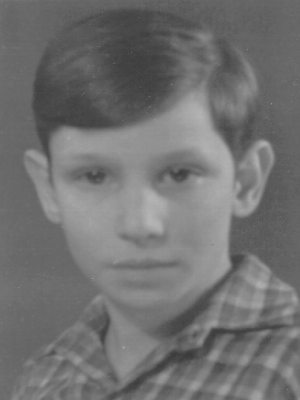
Born: December 17, 1926
Birthplace: Berlin, Germany
Hans-Georg Isaac
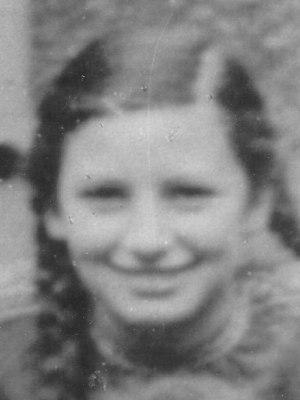
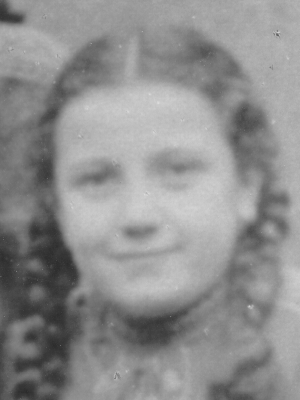
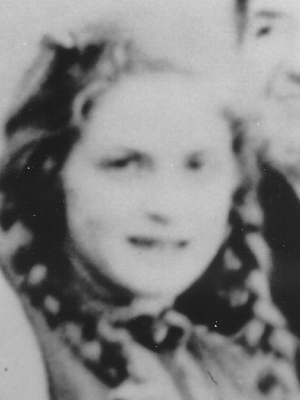
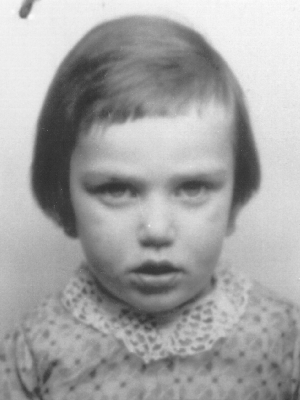
Hans-Georg Isaac, the older child of Anna and Friedrich Isaac, was born on December 17, 1926. His father, a writer, used the pen name Friedrich Victor, and Hans-Georg and his sister were also known by that name. Hans-Georg and his family lived in Berlin, the large, very sophisticated capital of Germany. The Jews of Berlin were highly assimilated and well integrated into the social and cultural fabric of the city.
Hans-Georg was a 7-year-old schoolboy when the Nazis came to power. They immediately began passing antisemitic measures. Many Jewish-owned businesses were confiscated, and Jewish citizens were barred from most professions and normal civic life. Jews were not allowed to attend public schools and were later forced to wear yellow stars to identify them as Jews. Their German citizenship was revoked, and they were forbidden to associate with non-Jews. Segregation laws were strictly enforced, and Jews were subjected to constant harassment and abuse.
After Hans-Georg’s parents divorced, they placed their children in a Jewish boarding school. The children were sent there in March 1938, when Hans-Georg was 11 years old. Hans-Georg and his sister were extremely close and looked after each other. Hans-Georg was a good student and was interested in sports.
After the widespread destruction and antisemitic acts of violence known as Kristallnacht , “The Night of Broken Glass”, which took place on the night of November 9-10, 1938, Hans-Georg‘s father tried to get his children out of the country.
In January 1939, he wrote to Lillie Herman-Philipp, a Jewish woman living in London who was trying to find places for Jewish children in homes and boarding schools throughout England. Because Mr. Isaac was unable to pay monthly maintenance fees due to his forced unemployment, the children’s applications were denied. After October 1941, the Jews of Germany were no longer allowed to emigrate. The children were hopelessly trapped.
Sometime between December 1941 and the spring of 1942, the Germans deported 16,000 Jews to a sealedoff ghetto in Riga, the capital of Latvia. The previous inhabitants, 30,000 local Jews, had been murdered by the Nazis to make room for the German Jews.
Hans-Georg, 15 years old, was among those sent to Riga. Conditions in the Riga Ghetto were horrendous.
There was little food and water. The Germans shut down most sanitary facilities. The ghetto was eventually emptied of its inhabitants. Most of the Jews were murdered by the Germans. Others were sent to labor camps where they were worked to death.
Nothing is known about Hans-Georg after he was deported to Riga. He was never heard from again.
Jewish life in Germany dates back to the days of the Roman Europe. As with the rest of Europe during the Middle Ages, the rights of Jews in Germany were greatly limited due to the influence of the church. In the late 18th and early 19th century, the situation changed and Jews found greater acceptance in German society. Most German Jews quickly assimilated into the environment around them. Many became prominent musicians, writers, teachers, scientists, politicians and businessmen. Antisemitism, though still a factor in German society, was not as prevalent as in Eastern Europe. As a result, German Jews were fiercely patriotic and fully identified with their country’s hopes and dreams.