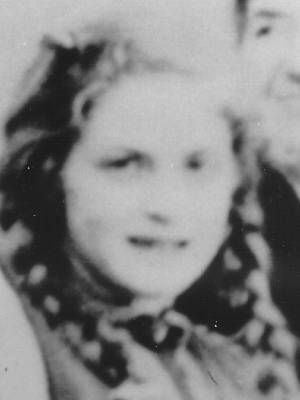
Born: September 3, 1927
Birthplace: Weseke, Germany
Hannelore Frank
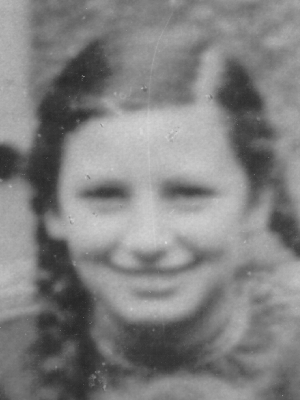
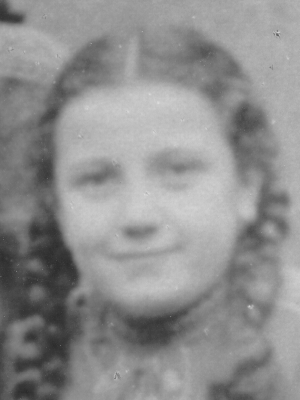
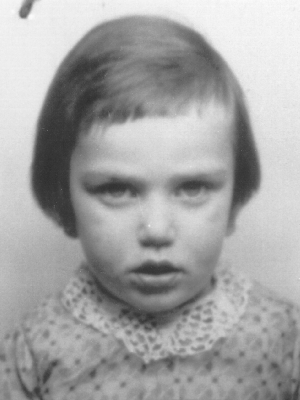
Hannelore Frank, the daughter of Olga and Karl Frank, was born on September 3, 1927 in Weseke, a small German town close to the Dutch border. Her father was a World War I veteran who worked as a cattle dealer. Olga died when Hannelore was 5 years old. Her father remarried two years later, and Hannelore became very close to her stepmother, Irma. Hannelore grew up surrounded by a large extended family, including four unmarried aunts.
The Nazis came to power in Germany in 1933, but at first, the Frank family did not take them seriously. During the early years of the Nazi regime, many Jewish-owned businesses were confiscated and Jews were barred from most professions. Jews were later required to wear yellow stars to identify them as Jews. Karl began smuggling Jewish refugees across the border into the Netherlands.
In September 1938, 10-year-old Hannelore began attending a school run by nuns. She was the only Jewish child in the school. On the night of November 9-10, 1938, countrywide acts of terror and destruction known as Kristallnacht, “Night of Broken Glass,” were directed against Germany’s Jews. Karl was arrested and sent to prison, and Hannelore was expelled from school because she was Jewish. The family was impoverished and trapped.
Early in 1941, Karl was released from prison. In December 1941, the family received notice that they were to be deported to “the East.” The Frank family, along with 16,000 other German Jews, was sent to Riga, Latvia, and forced to live in a sealed-off ghetto. The previous residents of the ghetto, over 30,000 local Jews, had been murdered by the Nazis to make room for the thousands of German Jews now being sent there. Conditions in the ghetto were horrendous. There was little food and water, and the Germans had shut down most sanitary facilities. Thousands died from starvation, disease, and exposure. Others were shot at the whim of the Nazis. Hannelore, 14 years old, lived in one room with her father, stepmother, little brother, little sister, and four aunts On November 2, 1942, while Hannelore was at work, the ghetto was emptied. The Nazis rounded up the prisoners who were not able to work, including Hannelore’s family, and gassed them in sealed transport vans. Hannelore and other able-bodied workers were sent to a work camp. When the Soviet army began advancing on the area, Hannelore and other Jewish workers were transported to slave labor camps in Germany. Forced to work at hard labor, Hannelore was constantly cold, hungry and afraid. Realizing that Germany was losing the war, the camp commander arranged for his prisoners to be exchanged through the Red Cross. On May 3, 1945, 17-year-old Hannelore was sent to Sweden, and freedom.
Jewish life in Germany dates back to the days of the Roman Europe. As with the rest of Europe during the Middle Ages, the rights of Jews in Germany were greatly limited due to the influence of the church. In the late 18th and early 19th century, the situation changed and Jews found greater acceptance in German society. Most German Jews quickly assimilated into the environment around them. Many became prominent musicians, writers, teachers, scientists, politicians and businessmen. Antisemitism, though still a factor in German society, was not as prevalent as in Eastern Europe. As a result, German Jews were fiercely patriotic and fully identified with their country’s hopes and dreams.