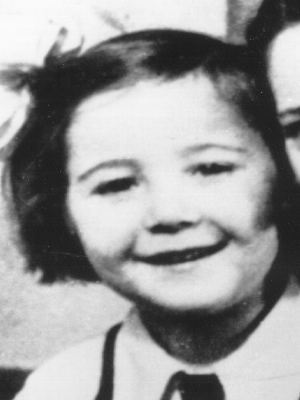
Born: Feburary 10, 1939
Birthplace: Prague, Czechoslovakia
Hannah Karpeles
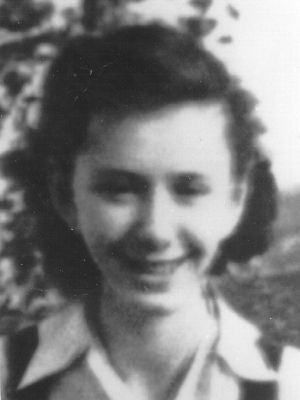
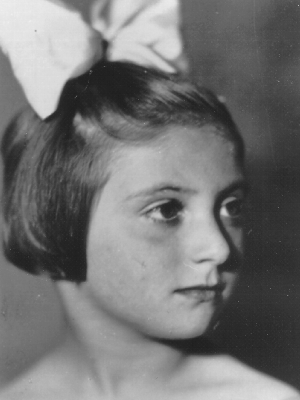
Hannah Karpeles, the daughter of Margit and Bedrich Karpeles, was born on February 10, 1939 in Prague, Czechoslovakia. Her parents had left Vienna, Austria, in 1935 for political reasons. Both worked in Prague in an Austrian émigré organization, where they were responsible for finding housing for the large number of Austrians who fled the Nazi takeover.
Soon after Hannah’s birth, the Nazis took over Czechoslovakia, instituting harsh anti-Jewish measures. Her father emigrated via Poland to England. Hannah, her mother, and her grandmother remained behind, hoping to join him when he got settled. In October 1941, the Nazis began deporting the Jews of Czechoslovakia to concentration camps. Hannah and her mother constantly feared deportation.
Hannah’s mother was arrested twice by the Gestapo because of her underground political activity, but each time she managed to get released.
In 1943, Hannah and her family were forced into the nearby Theresienstadt Transit Camp-Ghetto. The ghetto was overcrowded, lacked adequate sanitation and food, and was infested with typhus-spreading vermin. People died daily of disease and malnutrition. Jews were continually packed into trains headed for Auschwitz Death Camp.
In October 1944, Hannah, her mother and her grandmother were sent to Auschwitz. Upon arrival, they were immediately taken off the train and murdered in the gas chambers.
Jews first came to the former Czechoslovakia in the 10th century. Though subjected to persecution and massacres, the community survived to become the home of many famous rabbis and a rich Jewish culture. Most of Czechoslovakia’s Jews were living in Prague by the 1700s. Others lived in small towns earning their living as traders, smiths, and craftsmen.
After World War I, Jews played a major role in the economic life of the country, most notably in textiles, food stuffs, wood and paper, mining and banking. They were also major contributors to their country’s cultural life, which included such figures as Franz Kafka and Max Brod. By the 1930s the Jewish community numbered approximately 375,000.