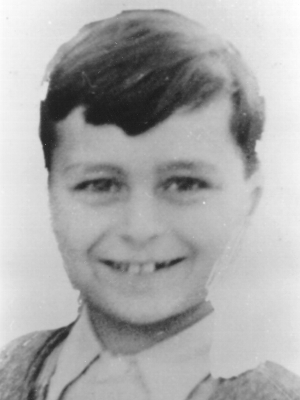
Born: October 30, 1935
Birthplace: Nyirmihalydi, Hungary
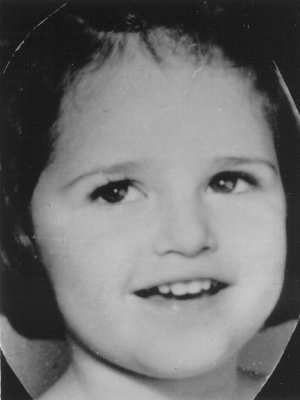
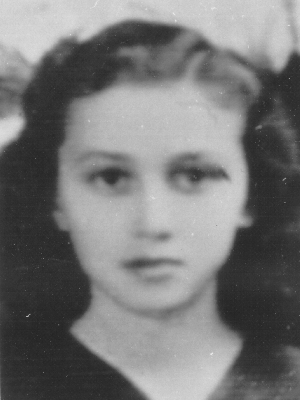
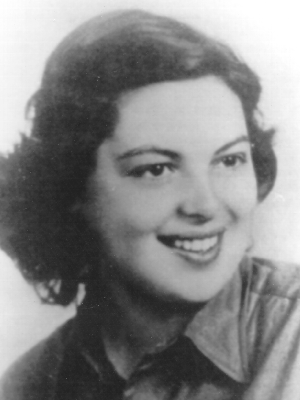
Georges Halpern
Georges Halpern was born on October 30, 1935, in Vienna, Austria. Georges was not yet 3 years old when Austria lost its independence and became part of Nazi Germany. Vienna had a Jewish population of nearly 175,000 and was one of the world’s leading Jewish cultural centers. However, Vienna was also notorious for its reputation as a city in which antisemitism flourished. When Germany took over in March 1938, thousands of Viennese willingly joined the Nazis in persecuting their Jewish neighbors.
Seeing no hope under the Nazis, the Halpern family fled to France. There Georges’ mother became seriously ill and had to be hospitalized for an extended period of time. To make matters worse, the Germans marched into France in the spring of 1940. Georges was shuttled from one shelter to the next, until he was finally sent to live in the children’s home in Izieu in May 1943.
Given the circumstances, life at the children’s home was comparatively serene. Outings and parties arranged by the sympathetic staff helped the children forget, if only temporarily, the cruel realities of the German occupation and the separation of families. Georges, who called himself Georgy, wrote regularly to his parents, describing his life in the children’s home. He lived for the day when he could be reunited with his parents, but that day was not to come.
On April 6, 1944, the home was raided by the Germans. Georges and his friends were arrested and shipped to Auschwitz Death Camp, where they were murdered in the gas chambers.
Jews first established a community in what is now Hungary in the 11th century. Despite hostility on the part of the church and local merchants, who objected to its success, the Jewish community survived frequent persecution, and, by 1787, had grown to 80,000. By 1900, nearly 900,000 Jews made their homes in Hungary. With new opportunities opened to them, many entered the professions, especially law and medicine. Others, especially in the smaller towns, were agricultural contractors, craftsmen and shopkeepers.
With great acceptance into Hungarian society came considerable assimilation, especially in the larger cities. Most Jews in the outlying districts and smaller towns, however, remained fervently orthodox. Hungary became a major center of both religious traditionalism and reform, a bastion of the ultra-orthodox Hassidic movement, and home to tens of thousands of Jews who had converted to Christianity.