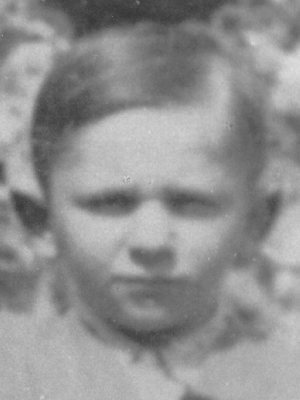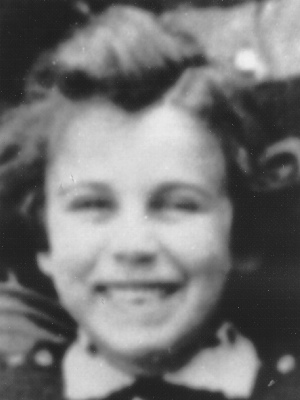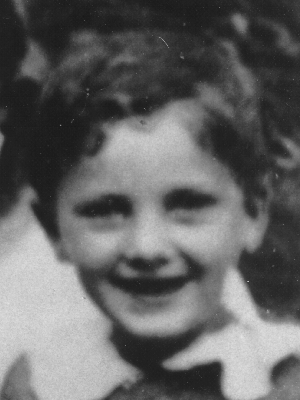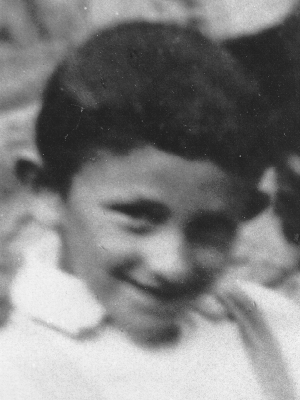
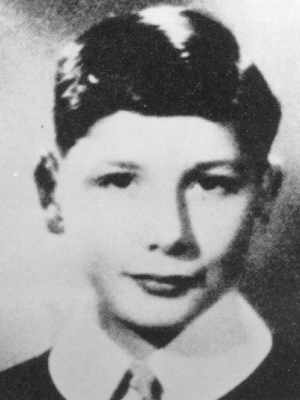
Born: April 23, 1932
Birthplace: Paris, France
Georges Andre Kohn
Georges Andre Kohn, the youngest of four children, was born in Paris, France. His father, Armand Kohn, who was related to the Rothschild family, was the director of the Baron de Rothschild Hospital in Paris, the largest Jewish hospital in France. His family was wealthy and close-knit.
Georges was an 8-year-old schoolboy when the Germans occupied Paris in June 1940. Because of his father’s connections and position, his family was exempted from the harsh restrictions placed upon the Jews of Paris under German rule.
In the summer of 1942, the Germans began deporting the Jews of France to death camps. Armand hid many Jews in his hospital on the pretense that they were seriously ill. The head of the Nazi secret police, Alois Brunner, had frequently visited the hospital, and Armand counted on their personal relationship to protect his family from deportation. During the last week of the German occupation of Paris, Brunner himself came to Georges’ home and arrested the family. Less than one month later, 12-year-old Georges, his grandmother, parents and siblings were forced onto a train and deported to Buchenwald Concentration Camp. Three days after the train began moving, Georges’ brother and one of his sisters broke the bars of the freight car’s small window and jumped out. When the train arrived at Buchenwald, the family was separated. Georges and his grandmother were sent to Auschwitz Death Camp.
At Auschwitz, Georges was sent to a special barrack. The 20 Jewish children in this barrack were to be used in horrific medical experiments. For this reason, the barrack was heated and the children were provided with decent food. The staff sang the children songs, taught them games, and distracted them from the horrible smells of the crematorium. Most of the children spoke only Polish, but Georges found one child who spoke French and they became close friends.
In November 1944, the children were transferred to Neuengamme Concentration Camp near Hamburg, Germany.
Soon after their arrival, Georges and the rest of the children were injected with tuberculosis cultures and became extremely ill. On April 20, 1945, when the British were less than three miles from the camp, all 20 children were brought to a school in Hamburg. The children were injected with morphine and murdered.
Georges died three days before his 13th birthday.
Jews have lived in France for more than 1500 years. Despite considerable persecution, which included massacres and expulsion during the Middle Ages, the community survived, in great part due to immigration of Jews from other lands in later centuries when conditions had improved.
On the eve of the French Revolution, approximately 40,000 Jews lived in France. Finding greater acceptance in society, Jews were able to take advantage of the great opportunities afforded them, and their economic position improved. The community established schools in the early 1800s and maintained a wide assortment of charitable and welfare institutions. Despite its European character, the French Jewish community was able to absorb Jewish immigrants from North Africa, where France once had colonies. By the eve of World War II, France’s Jewish population, including refugees from other parts of Europe, numbered approximately 350,000.