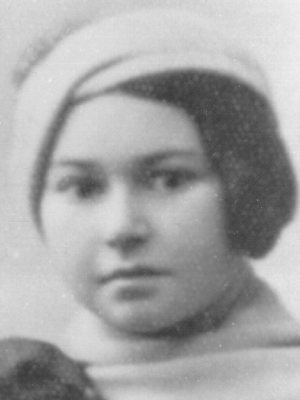
Born: 1924
Birthplace: Kovel, Poland
Freda Gabe
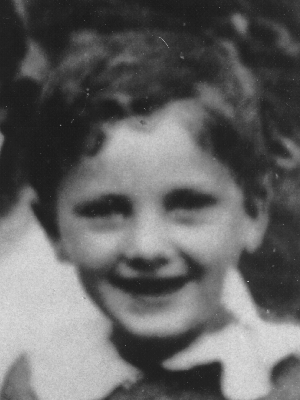
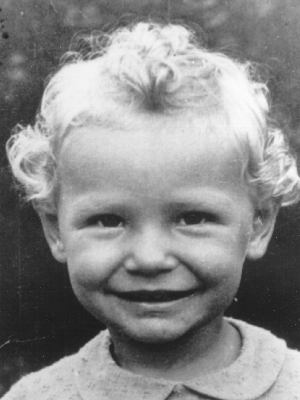
Freda Gabe, the older daughter of Rochel and Boruch Gabe, was born in 1924 in the small town of Kovel, Poland.
More than half of the population of Kovel was Jewish. Most earned their living from the production of beer and leather, or construction. Some worked in wholesale and retail businesses. Jews were active in local politics, and won 10 seats in the municipal elections of 1939. Two Jewish periodicals were published in Kovel. The community also supported a high school, elementary school and kindergarten. A drama circle provided a center for literary activities.
On September 1, 1939, Germany invaded Poland, starting World War II. At that time, the Soviet Union and Germany were allies. They had agreed to divide Poland in half, each controlling one part. Kovel was occupied by the Soviet Union, and the Jews living in Kovel felt relatively secure, since they had little information about the rise of antisemitism under the German occupation. However, soon after the Soviet occupation, public Jewish life was discontinued, and private commerce almost ceased to exist, causing great economic hardship.
On June 27, 1941, when Freda was 17 years old, Kovel was occupied by the Germans. A few weeks later, the Germans collected some 200 Torah scrolls from all the synagogues and burned them. By the end of 1941, thousands of Jews had been murdered in a nearby forest by Einsatzgruppen, special mobile German killing squads.
On May 25, 1942, nearly 24,000 Jews from Kovel and the surrounding villages were forced into a closed-off ghetto.
The Germans immediately murdered the elderly, the sick, and the children. The ghetto had been set up in two sections. On July 22, 1942, one section was emptied and its inhabitants murdered. Over the next few months, the Jews remaining in the other section of the Kovel ghetto were taken into the forest and shot.
Jews first came to Poland from central Europe at the end of the 11th century, as refugees from the Crusades. They were welcomed by the Polish nobility, which was eager to use their skills in modernizing their country. Jews were granted charters to live in specific towns and engage in various businesses and crafts. After the massacre of 1648-1649 by the Cossacks, Poland’s surviving Jews were impoverished.
Despite the economic poverty, however, religious and cultural life was rich. Poland was home to some of the world’s greatest rabbis and scholars. Religious observance throughout the large cities and smaller towns, known as shtetlach, was the norm, and religious scholarship was highly prized. By the late 19th and early 20th century, Jewish cultural life in Poland expanded to include political parties and Zionist groups, as well as a wide range of literature and sports clubs. By the 1930s, Poland’s Jews numbered over 3 million and accounted for 10% of the total population.