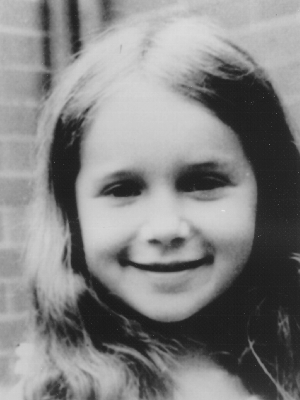
Born: May 21, 1932
Birthplace: Leeuwarden, The Netherlands
Eva Beem
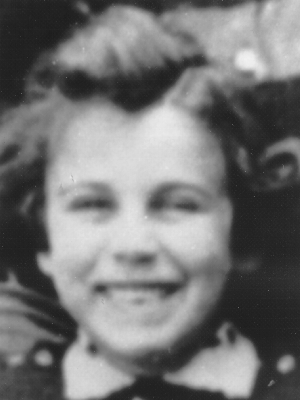
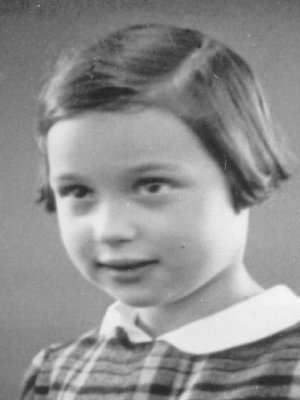
Eva Beem, the daughter of Rosette and Hartog Beem, was born May 21, 1932. Eva’s father was a high school teacher in the small city of Leeuwarden, in northern Holland. The Jews of the Netherlands were well integrated into the general population, and they were active in all aspects of the country’s social, cultural and economic life.
Eva was an 8-year-old schoolgirl when the Germans invaded the Netherlands in May 1940. They immediately took steps to separate the Jews from the rest of the population. Beginning in October 1940, they forced Jewish businesses to close and banned Jews from most professions. Even the rich became poor, and most of the working class could barely survive. At first, the Dutch population resisted the antiJewish measures enacted by the Germans. The Germans reacted brutally and were able to break up most organized resistance.
By July 1941, many Jews were forced into restricted ghetto areas. After May 1942, all Jews were required to wear yellow stars that identified them as Jews. In mid-July 1942, the Germans began rounding up the Netherlands’ Jewish citizens. They were first taken to transit camps and then to death camps in Poland, where they were murdered.
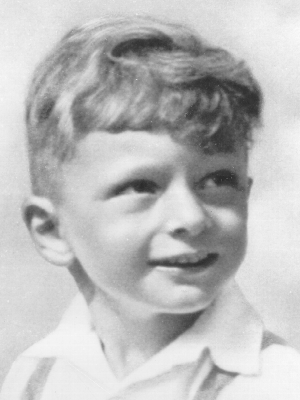
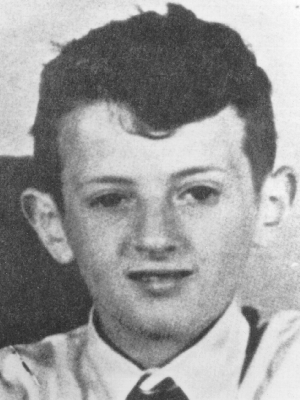
Eva’s parents decided that the family would go into hiding. They felt that the children would be safer posing as non-Jews in a rural village. Eva and her younger brother, Abraham, were sent to the village of Ermelo. They were fortunate to find a Christian family willing to risk death to save them. Eva was given a new name and identity. She was known as Linni de Witt, and she attended school along with the other village children.
The Nazis, realizing that many Jewish children had been sent into hiding, intensified their search. They found collaborators willing to turn them in for payment. Eva was denounced as a Jew in February 1944.
Eva and Abraham were arrested, sent to Westerbork Transit Camp, and then deported to Auschwitz Death Camp in Poland. Both were murdered upon arrival at Auschwitz.
Although a Jewish presence in the Netherlands can be documented from the 12th century, the country’s modern Jewish community actually dates back to the 1600s. At that time, Spanish and Portuguese Marranos, or Conversos (Jews who converted to Catholicism to escape the Inquisition, but secretly practiced Judaism) found a haven in the Netherlands. They were later joined by Jews from central and eastern Europe, who quickly outnumbered them. The comparatively liberal atmosphere of the Netherlands afforded increased opportunities to the Dutch Jewish community. Jews were heavily represented in various industries including the diamond trade and textile manufacturing. Many also achieved prominence in medicine and law. A Jew, Lodewijk Visser, rose to become Chief Justice of the Netherland’s Supreme Court shortly before World War II. With increased social acceptance, however, came increased assimilation. While there was always an Orthodox presence in the country, most of Holland’s Jewish community was only moderately observant of Jewish tradition, and intermarriage was common.
On the eve of World War II, more than 125,000 Jews lived in the Netherlands.