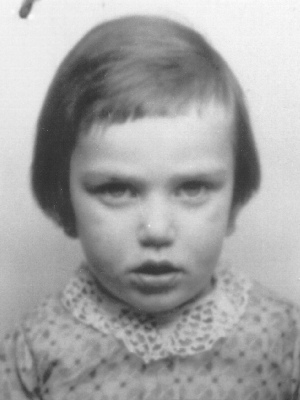
Born: September 9, 1935
Birthplace: Hamburg, Germany
Ellinor Wolff
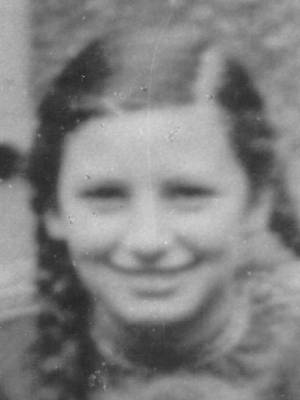
Ellinor Wolff, the youngest daughter of Lilli and Georg Wolff, was born in Hamburg, Germany on September 9, 1935. The Jews of Hamburg were prosperous and well integrated into the city’s social and cultural life.
They were prominent in most professions. Ellinor’s father worked as a teacher and cantor for Hamburg’s large Reform Jewish community.
Ellinor was born just before Nazi Germany passed the anti-Jewish “Nuremberg Laws.” Jews were stripped of their German citizenship and were segregated from the population as a whole. Later, Jews were barred from most professions, public schools and many public places, and Jewish businesses were confiscated. Many Jews began to flee the country, but others, like Ellinor’s parents, believed that the restrictions were only temporary and would soon end.
On the night of November 9-10, 1938, the Jews of Germany experienced the wide-scale destruction and antisemitic acts of violence known as Kristallnacht , “Night of Broken Glass.”
After Kristallnacht , Ellinor’s parents tried desperately to send their children to safety. They wrote to refugee assistance organizations in England, begging them to find places for their three daughters. The two older girls were able to leave Germany on a Kindertransport , but Ellinor and her parents remained trapped in Germany.
In December 1941, when Ellinor was 6 years old, her family, along with 16,000 other German Jews, was deported to Riga, Latvia. The 30,000 local Jews who had already been living in the sealed-off ghetto had been murdered by the Germans to make room for the newcomers. There was inadequate food, water, and sanitary facilities. Thousands died from starvation, disease, and exposure.
By December 1943, the ghetto was emptied of its population. Most of the inhabitants were murdered by the Germans or sent to labor camps where they were worked to death.
Ellinor disappeared without a trace.
Jewish life in Germany dates back to the days of the Roman Europe. As with the rest of Europe during the Middle Ages, the rights of Jews in Germany were greatly limited due to the influence of the church. In the late 18th and early 19th century, the situation changed and Jews found greater acceptance in German society. Most German Jews quickly assimilated into the environment around them. Many became prominent musicians, writers, teachers, scientists, politicians and businessmen. Antisemitism, though still a factor in German society, was not as prevalent as in Eastern Europe. As a result, German Jews were fiercely patriotic and fully identified with their country’s hopes and dreams.