Born: September 8, 1929
Birthplace: Amsterdam, the Netherlands
Elinor Oettinger
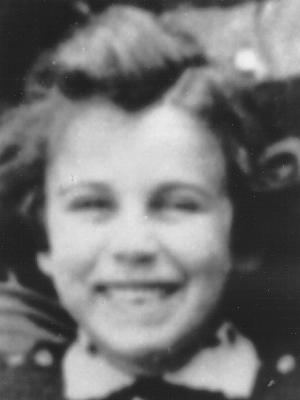
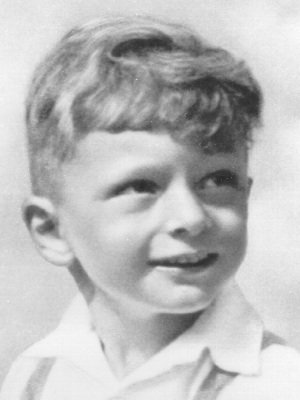
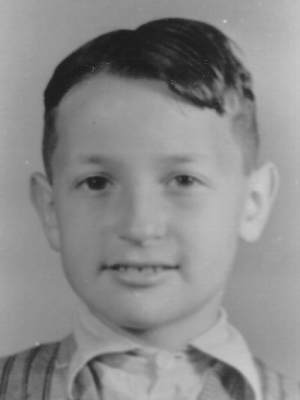
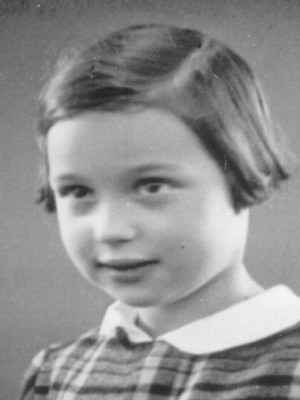
Elinor Oettinger, the older child of Betty and Herbert Oettinger, was born on September 9, 1929 in Amsterdam, the Netherlands. Her parents were originally from Hamburg, Germany, and Herbert served in the German army in World War I, receiving the Iron Cross 1st Class medal. Betty and Herbert later moved to the Netherlands to escape antisemitism. Herbert was a successful tobacco merchant, and the family lived comfortably in Amsterdam, where Jews were well-integrated into all aspects of Dutch economic and social life.
When the Germans occupied the Netherlands in May 1940, they instituted harsh antisemitic measures. Jews were barred from most professions and from public schools. Jewish businesses were shut down. Elinor had to attend a private Jewish school, and could no longer play with her non-Jewish friends. She was forced to wear a yellow star to identify her as a Jew. Friends, neighbors and teachers suddenly began to disappear.
On June 20, 1943, the Germans conducted a massive door-to-door raid. Elinor and her family were arrested and sent to Westerbork Transit Camp, from where they were deported, in spring 1944, to Theresienstadt Transit CampGhetto in Czechoslovakia. Severely crowded and lacking food, medicine and heat, the ghetto was infested with vermin. Elinor and her family were always hungry and constantly lived with the fear of being deported to the death camps in Poland. Herbert worked in the administration of the camp.
In September 1944, a day after Yom Kippur (Jewish Day of Atonement), Elinor’s father was transported to Auschwitz Concentration Camp in Poland. Two weeks later, on October 18, 1944, Elinor, her brother and their mother were deported to Auschwitz. They were gassed immediately upon arrival.
Although a Jewish presence in the Netherlands can be documented from the 12th century, the country’s modern Jewish community actually dates back to the 1600s. At that time, Spanish and Portuguese Marranos, or Conversos (Jews who converted to Catholicism to escape the Inquisition, but secretly practiced Judaism) found a haven in the Netherlands. They were later joined by Jews from central and eastern Europe, who quickly outnumbered them. The comparatively liberal atmosphere of the Netherlands afforded increased opportunities to the Dutch Jewish community. Jews were heavily represented in various industries including the diamond trade and textile manufacturing. Many also achieved prominence in medicine and law. A Jew, Lodewijk Visser, rose to become Chief Justice of the Netherland’s Supreme Court shortly before World War II. With increased social acceptance, however, came increased assimilation. While there was always an Orthodox presence in the country, most of Holland’s Jewish community was only moderately observant of Jewish tradition, and intermarriage was common.
On the eve of World War II, more than 125,000 Jews lived in the Netherlands.