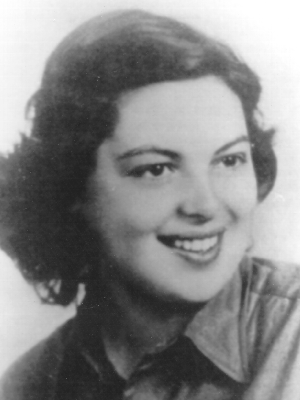
Born: May 1, 1927
Birthplace: Nyirmihalydi, Hungary
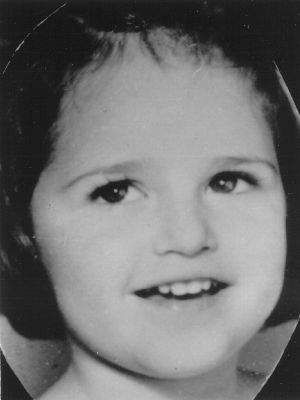
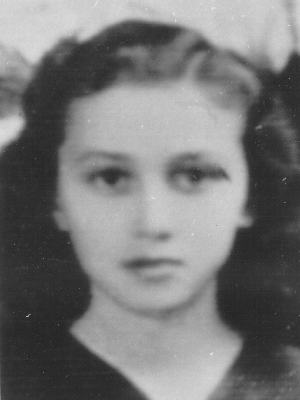
Ebi Gruenblatt
Ebi Gruenblatt, the daughter of Margit and Morris Gruenblatt, was born on May 1,1927, in Nyirmihalydi.
Her father was the manager of a large rural estate. The youngest of four children, Ebi had three older brothers who adored her. Her family enjoyed a comfortable, affluent life, and Mr. Gruenblatt was widely known and well-respected.
The Germans occupied Hungary in March 1944. Before Ebi’s seventeenth birthday, the Nazis arrested her family, along with other Jews in the area, and imprisoned them in the local synagogue without food or water. After two weeks of deprivation, they were forced to march through the countryside until they reached the city of Nyiregyhaza, where they were herded into a closed-off ghetto. Lacking work and the means to earn a living, the Gruenblatts were in danger of starving to death. Christian friends helped by smuggling food into the ghetto. Ebi and her family reported for “resettlement” in mid-May. Shoved into cattle cars, traveling under conditions that barely sustained human life, they arrived in Auschwitz Concentration Camp five days later.
In June, Ebi and her mother, passing as sisters, were sent to the Plaszow Labor Camp near Cracow. Filled with constant fear, Ebi and her mother were put to work moving heavy rocks from one location to another.
They were being worked to death. In late September 1944, Ebi and her mother were brought back to Auschwitz.
They were then sent to Augsburg, Germany, to work in the K.U.K.A. Ammunition Factory. Soon after, the area was heavily bombed by the Allies, and they were evacuated, first to Dachau Concentration Camp, and then to a work camp near Muehldorf. Ebi was given work as a registrar, since she knew German.
When the Allies began bombing Muehldorf at the end of April 1945, Ebi and her mother, along with other inmates, were packed into cattle cars. The Germans planned to take them to the Alps and murder them.
The tracks were almost completely destroyed, and the train could not travel far. Allied planes strafed the train while the prisoners took refuge under the boxcars. Ebi, her mother, and others escaped, but the Germans hunted them down and returned them to the train. Allied soldiers finally arrived on the scene and liberated them.
Ebi celebrated her eighteenth birthday as a free person.
Jews first established a community in what is now Hungary in the 11th century. Despite hostility on the part of the church and local merchants, who objected to its success, the Jewish community survived frequent persecution, and, by 1787, had grown to 80,000. By 1900, nearly 900,000 Jews made their homes in Hungary. With new opportunities opened to them, many entered the professions, especially law and medicine. Others, especially in the smaller towns, were agricultural contractors, craftsmen and shopkeepers.
With great acceptance into Hungarian society came considerable assimilation, especially in the larger cities. Most Jews in the outlying districts and smaller towns, however, remained fervently orthodox. Hungary became a major center of both religious traditionalism and reform, a bastion of the ultra-orthodox Hassidic movement, and home to tens of thousands of Jews who had converted to Christianity.