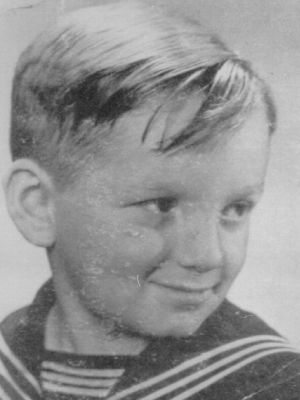
Born: October 8, 1935
Birthplace: Krakow, Poland
Bronislaw Honig
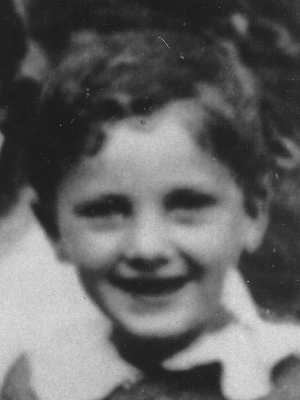
Bronislaw Honig, the son of Rose and David Honig, was born on October 8, 1935, in Krakow, the third largest city in Poland. His father was a salesman in a hardware store, and his mother worked as a dressmaker. His grandmother stayed home to care for him. Bronislaw was a bright, happy little boy; he was good-looking and well-mannered.
Jewish cultural and social life flourished in Krakow between the two world wars. In 1939, Krakow had 60,000 Jewish citizens.
On September 6, 1939, Krakow was occupied by the Germans, who immediately began persecuting the Jews.
Jewish property was confiscated and several synagogues were burned down. By March 1941, approximately 40,000 Jews had been expelled to neighboring towns and the property they left behind was seized. At the same time, a closed-off ghetto was established. The worst problems included overcrowding, hunger, and poor sanitary conditions. The population was impoverished, and the Germans set up several factories in the ghetto, where they used the Jews as slave laborers. Many Jews died in the streets from starvation, disease, and exposure.
In May 1942, the Germans began rounding up Krakow’s remaining Jews and deporting them to concentration camps. Many strong and healthy Jews were sent to work in the Plaszow Slave Labor Camp. Rose and David were sent to Plaszow in January 1943, but they arranged for Bronislaw to stay with a friendly Jewish policeman. David was forced to work in a warehouse outside the camp. When the Krakow ghetto was about to be emptied, the policeman sent a message to David, who smuggled himself out of Plaszow and back into the ghetto at night. He could hear shots being fired all around him. David took Bronislaw back to Plaszow with him, hidden in a suitcase on a cart filled with clothes left behind by the deported ghetto residents. A few days later, after another child was discovered living in the camp and shot, David desperately sought a way to get Bronislaw to safety. A young Christian woman who worked with him in the warehouse offered to take the child. Bronislaw was smuggled out in a backpack to the woman, who waited outside the camp. Bronislaw and the young woman were betrayed to the Germans by her stepfather. They were both arrested and murdered.
Bronislaw was 7 years old.
Jews first came to Poland from central Europe at the end of the 11th century, as refugees from the Crusades. They were welcomed by the Polish nobility, which was eager to use their skills in modernizing their country. Jews were granted charters to live in specific towns and engage in various businesses and crafts. After the massacre of 1648-1649 by the Cossacks, Poland’s surviving Jews were impoverished.
Despite the economic poverty, however, religious and cultural life was rich. Poland was home to some of the world’s greatest rabbis and scholars. Religious observance throughout the large cities and smaller towns, known as shtetlach, was the norm, and religious scholarship was highly prized. By the late 19th and early 20th century, Jewish cultural life in Poland expanded to include political parties and Zionist groups, as well as a wide range of literature and sports clubs. By the 1930s, Poland’s Jews numbered over 3 million and accounted for 10% of the total population.