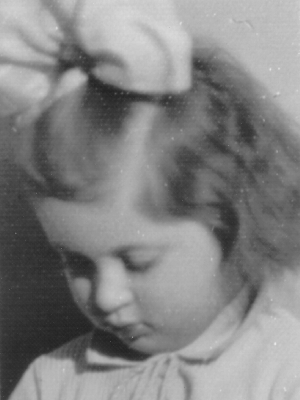
Born: 1934
Birthplace: Warsaw, Poland
Alinka
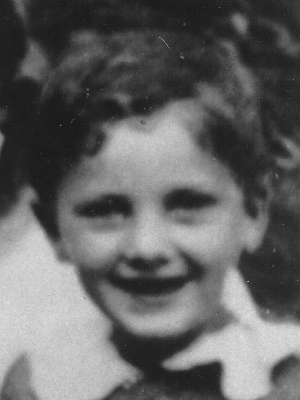
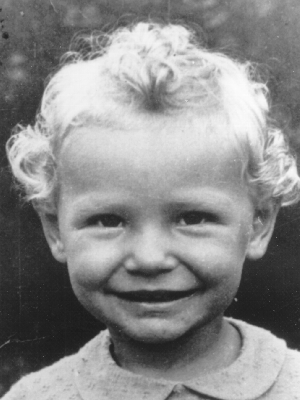
Alinka was the daughter of Lilka Cukierman (We only know Alinka’s mother’s maiden name, we do not know her father’s name). She lived in Warsaw, Poland, a large, cosmopolitan city, home to Europe’s largest Jewish community. Alinka’s grandfather was highly involved in the community, and the family lived in an affluent area. Alinka loved to play with her dolls and stuffed animals. Part of a large, loving, highly educated family, Alinka had a comfortable early childhood.
In September 1939, Alinka was 5 years old when the Germans occupied her city. By October 1940, Alinka, her family, and all the other Jewish residents of Warsaw were forced to leave their homes and to move into the ghetto, a run-down area of the city. On November 15, walls were built around the Warsaw Ghetto, cutting it off from the rest of the world. Over 400,000 people were packed into apartments on 73 streets.
Lacking money and forbidden to work, most residents were quickly impoverished. Food, medicine and heat were inadequate. Thousands died of starvation, exposure and disease. Children risked their lives to smuggle food into the ghetto for their families. Amidst all the horrors of the ghetto, underground schools and other cultural events were organized.
In July 1942, the Germans began rounding up and deporting ghetto residents in massive raids. Few were exempt. Packed like cattle into freight cars, they were sent to Treblinka Death Camp, where they were immediately taken to the gas chambers and murdered.
By September, only 60,000 Jews, mostly young men and women, were left in the ghetto. The last remnants of their families, they resolved to fight the Germans. On Passover eve, April 19, 1943, the Germans began what they believed to be the final roundup and deportation. Instead, they were met with organized, armed resistance. The Germans began systematically burning buildings, trying to force people out of hiding.
Armed mostly with home-made grenades and other incendiary devices, the young Jewish fighters fought the Germans, house by house, for almost a month. The ghetto was turned into one great burning torch. On May 16, the uprising was defeated.
Nothing is known about Alinka or her family after they were forced into the ghetto and cut off from the world. No trace has ever been found.
Jews first came to Poland from central Europe at the end of the 11th century, as refugees from the Crusades. They were welcomed by the Polish nobility, which was eager to use their skills in modernizing their country. Jews were granted charters to live in specific towns and engage in various businesses and crafts. After the massacre of 1648-1649 by the Cossacks, Poland’s surviving Jews were impoverished.
Despite the economic poverty, however, religious and cultural life was rich. Poland was home to some of the world’s greatest rabbis and scholars. Religious observance throughout the large cities and smaller towns, known as shtetlach, was the norm, and religious scholarship was highly prized. By the late 19th and early 20th century, Jewish cultural life in Poland expanded to include political parties and Zionist groups, as well as a wide range of literature and sports clubs. By the 1930s, Poland’s Jews numbered over 3 million and accounted for 10% of the total population.