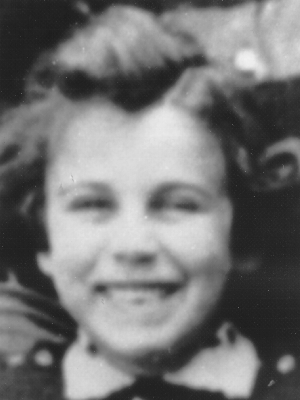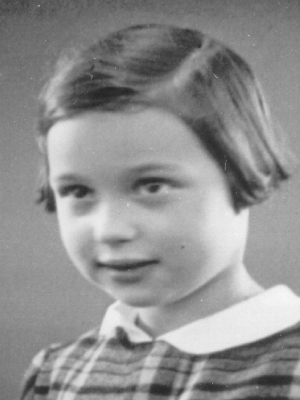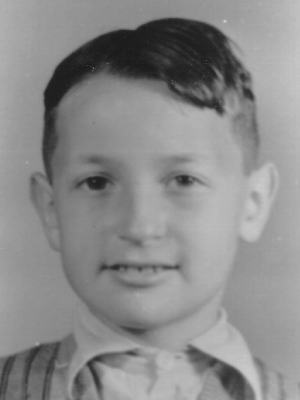
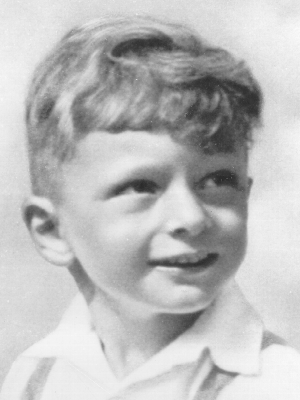
Born: October 7, 1937
Birthplace: Amsterdam, the Netherlands
Alfred Kristeller
Alfred Kristeller, the son of Ilse and Adolph Kristeller, was born on October 7, 1937, in Amsterdam, the Netherlands.
The Kristellers had moved in 1933 to Amsterdam from Düsseldorf, Germany, to escape living under Nazi oppression.
Amsterdam was a large, cosmopolitan city with a substantial, assimilated, Jewish population. Jews were found in all occupations and contributed to the economic, cultural and social life of the city. Jews were considered as equals by their non-Jewish fellow citizens. Life was comfortable for Alfred and his parents. Alfred’s father worked for the Deutsche Bank in Amsterdam.
In May, 1940, the Germans invaded the Netherlands and began enacting harsh antisemitic measures. Jewish businesses and bank accounts were confiscated and Jews were barred from most professions. In addition, Jews were excluded from public schools and universities. When the Nazis began perpetrating acts of violence against the Jews, the Dutch people were outraged. Large-scale strikes were organized in protest. They were soon crushed by the Germans. The Jews of Amsterdam were forced to live in sealed-off ghettos. After May 1942, they were forced to wear yellow stars to identify them as Jews. By the end of 1942, approximately 38,500 Jews had been deported from the Netherlands to death camps in Poland. Dutch Christians made thousands of heroic efforts to save Jews and hide them, but most of the Jews were caught by the Nazis.
Alfred and his parents were deported to Sobibor Death Camp near Lublin, Poland. As soon as they stepped off the overcrowded, sealed cattle car in which they were forced to travel, they were taken to the gas chambers and murdered.
Although a Jewish presence in the Netherlands can be documented from the 12th century, the country’s modern Jewish community actually dates back to the 1600s. At that time, Spanish and Portuguese Marranos, or Conversos (Jews who converted to Catholicism to escape the Inquisition, but secretly practiced Judaism) found a haven in the Netherlands. They were later joined by Jews from central and eastern Europe, who quickly outnumbered them. The comparatively liberal atmosphere of the Netherlands afforded increased opportunities to the Dutch Jewish community. Jews were heavily represented in various industries including the diamond trade and textile manufacturing. Many also achieved prominence in medicine and law. A Jew, Lodewijk Visser, rose to become Chief Justice of the Netherland’s Supreme Court shortly before World War II. With increased social acceptance, however, came increased assimilation. While there was always an Orthodox presence in the country, most of Holland’s Jewish community was only moderately observant of Jewish tradition, and intermarriage was common.
On the eve of World War II, more than 125,000 Jews lived in the Netherlands.