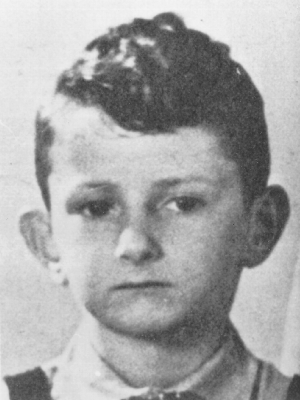
Born: May 31, 1936
Birthplace: Eindhover, The Netherlands
Alexander Hornemann
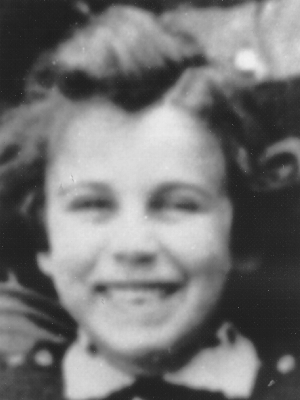
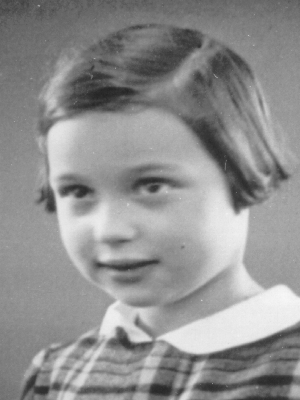
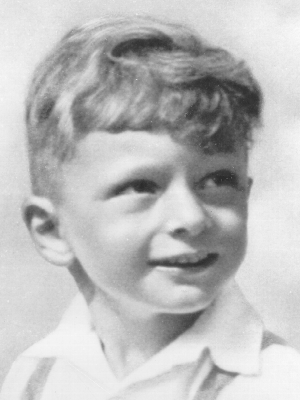
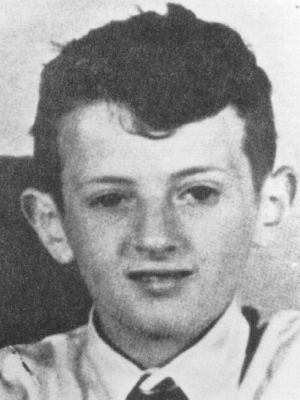
Alexander Hornemann, also known as Lex, was the son of Elizabeth and Philip Hornemann. He was born in Eindhoven, the Netherlands, on May 31, 1936. His father, an executive with the Philips Corporation, provided a comfortable living for his family.
When the Germans occupied the Netherlands in May 1940, Alexander was 4 years old. The Nazis immediately instituted harsh anti-Jewish measures. Alexander’s family was temporarily exempted from many of the restrictions because of his father’s position with the Philips Corporation. After the Germans began deporting Jews to concentration camps, the Philips Corporation set up a special section for its Jewish employees.
On August 18, 1943, German troops surrounded the Philips plant in Eindhoven and arrested all the Jews.
Alexander’s father and the rest of the Jewish employees were sent to Vught, a Dutch concentration camp, where they were put to work in a Philips operation that employed over 3,000 prisoners. The Philips workers received extra rations and were given the special privilege of living together with their wives and children. When a Philips Corporation representative told Alexander’s mother that the company could guarantee her family’s safety only if she joined her husband in the camp, she felt that she had no choice but to go.
On June 3, 1944, the Hornemanns were deported to Auschwitz-Birkenau Concentration Camp in Poland.
Alexander and his brother remained with their mother and were sent to the women’s barracks in Birkenau.
Conditions in the camp were horrendous. There was little food, and disease was rampant. Alexander’s mother contracted typhoid fever three months after their arrival and soon died.
A few days after their mother’s death, Alexander and his brother, along with 18 other Jewish children, were chosen to be used in horrific medical experiments. In the fall of 1944, the children were transferred to Neuengamme Concentration Camp. The children were injected with tuberculosis cultures and became extremely ill.
On April 20, 1945, when the British were less than three miles from the camp, the sick children were put onto a truck and brought to a school in Hamburg. They were injected with morphine and hanged.
Alexander was 8 years old.
Although a Jewish presence in the Netherlands can be documented from the 12th century, the country’s modern Jewish community actually dates back to the 1600s. At that time, Spanish and Portuguese Marranos, or Conversos (Jews who converted to Catholicism to escape the Inquisition, but secretly practiced Judaism) found a haven in the Netherlands. They were later joined by Jews from central and eastern Europe, who quickly outnumbered them. The comparatively liberal atmosphere of the Netherlands afforded increased opportunities to the Dutch Jewish community. Jews were heavily represented in various industries including the diamond trade and textile manufacturing. Many also achieved prominence in medicine and law. A Jew, Lodewijk Visser, rose to become Chief Justice of the Netherland’s Supreme Court shortly before World War II. With increased social acceptance, however, came increased assimilation. While there was always an Orthodox presence in the country, most of Holland’s Jewish community was only moderately observant of Jewish tradition, and intermarriage was common.
On the eve of World War II, more than 125,000 Jews lived in the Netherlands.