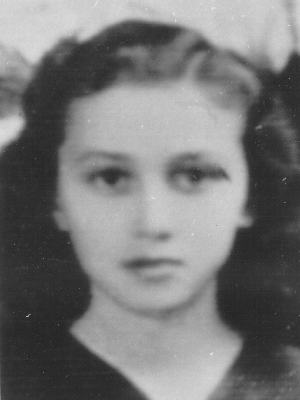
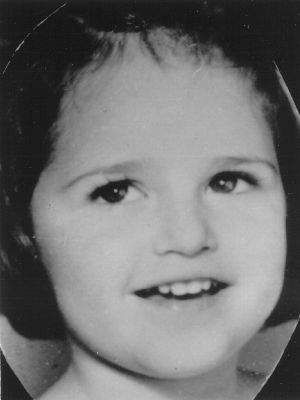
Born: November 17, 1935
Birthplace: Pestszenterzsebet, Hungary
Agnes Ringwald
Agnes Ringwald, the only child of Ilona and Eugene Ringwald, was born on November 17, 1935 in Pestszenterzsebet, Hungary. Her father was a medical doctor. The town’s 4,522 Jewish citizens were mostly laborers, but some were farmers, teachers, businessmen, lawyers, and doctors. The Jewish community established charitable organizations, cultural centers and educational programs. In 1922, a Jewish school was opened.
Pestszenterzsebet was located near Budapest. It was an industrial town manufacturing textiles, soap, matches and other goods. The town’s Jewish citizens had an important role in the development of the town’s industries and owned many of the businesses and factories.
With the Nazi rise to power, Hungary allied itself with Germany. As early as 1938, the Hungarian government was urged to deport its Jews to concentration camps, which it was not willing to do. Jews were considered important to Hungary’s economic stability. Instead, harsh antisemistic measures were enacted, and many Jewish men were forced to join hard labor battalions.
In March 1943, when Agnes was 7 years old, Hungary tried to break its alliance with Germany. A year later, dissatisfied with Hungary’s refusal to collaborate, Hitler ordered his troops to invade Hungary. On March 19, 1944, German troops occupied all of Hungary and immediately initiated their plan to kill all the Jews.
Assisted by Hungarian collaborators, the Germans deported local Jews to ghettos and concentration camps.
Agnes and her parents were rounded up and forced into the town’s ghetto. In July 1944, the Ringwalds, together with the remaining 3,000 Jews in the ghetto, were among the last to be deported to Auschwitz Death Camp in Poland. Agnes’ family was taken immediately to the gas chambers and murdered.
Jews first established a community in what is now Hungary in the 11th century. Despite hostility on the part of the church and local merchants, who objected to its success, the Jewish community survived frequent persecution, and, by 1787, had grown to 80,000. By 1900, nearly 900,000 Jews made their homes in Hungary. With new opportunities opened to them, many entered the professions, especially law and medicine. Others, especially in the smaller towns, were agricultural contractors, craftsmen and shopkeepers.
With great acceptance into Hungarian society came considerable assimilation, especially in the larger cities. Most Jews in the outlying districts and smaller towns, however, remained fervently orthodox. Hungary became a major center of both religious traditionalism and reform, a bastion of the ultra-orthodox Hassidic movement, and home to tens of thousands of Jews who had converted to Christianity.