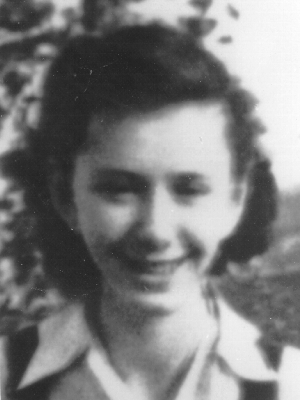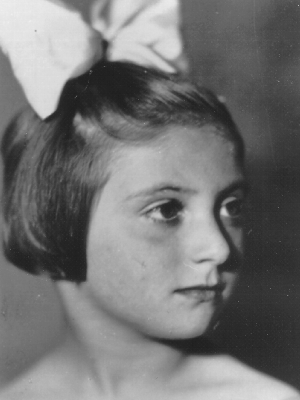
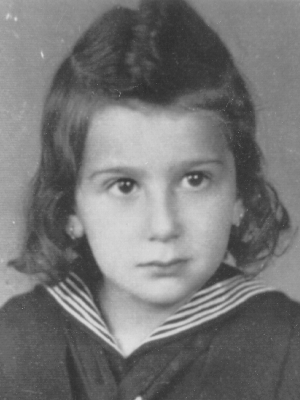
Born: April 13, 1939
Birthplace: Chust, Czechoslovakia
Agnes Lebovics
Agnes Lebovics, the older daughter of Marketa and Mor Lebovics, was born on April 13, 1939 in Chust, Czechoslovakia. Czechoslovakia had a rich Jewish culture and was home to many scholars and leaders.
Agnes’ father came from a family of wealthy livestock dealers and worked in the family business. Her mother’s family owned a flourishing print shop.
In 1939, the peaceful life of the Lebovics family came to an end when Hungary took over the part of Czechoslovakia where the family lived. The Hungarians immediately imposed harsh restrictions upon all Jews and life became extremely difficult. Agnes’ father was deported to a forced labor camp, from which he was allowed short visits home. In 1941, the economic and social restrictions imposed by the Hungarians became more severe. Agnes and her family struggled to survive.
Early in 1944, the Germans occupied Chust and immediately increased the persecution of the Jewish population. Agnes, her younger sister, and their mother were forced to leave their home and their possessions, including the family dog, Boombi. Agnes and her sister cried for their big white dog and could not understand why they were not allowed to bring him with them. Together with over 10,000 Jews from the surrounding area, the family was moved into a closed, overcrowded ghetto. The girls and their mother were allowed to live in their grandparents’ apartment within the ghetto.
On May 23, 1944, Agnes and her family were forced into sealed, packed cattle cars, not knowing where they were going. After three days and two nights without food, water or sanitary facilities, they arrived at Auschwitz Death Camp in Poland.
The women were sent to stand in line. Agnes and her sister held their mother’s hand. A Polish guard came over to Agnes’ mother and told her that if she wanted her children to live, she should give them to their grandmother and say that they were not hers. She would then go to another line of people chosen to work. By working, Agnes’ mother would be able to provide food for her daughters. Mrs. Lebovics called over to her father, who stood in another line with the men, and asked him what to do. He told her to give the children to her mother and move into the other line. When the girls cried out for her and called her name, she returned to them but was beaten back into line by a German guard. Agnes, her sister, their grandmother and great-grandmother were taken straight to the gas chambers where they were murdered.
Jews first came to the former Czechoslovakia in the 10th century. Though subjected to persecution and massacres, the community survived to become the home of many famous rabbis and a rich Jewish culture. Most of Czechoslovakia’s Jews were living in Prague by the 1700s. Others lived in small towns earning their living as traders, smiths, and craftsmen.
After World War I, Jews played a major role in the economic life of the country, most notably in textiles, food stuffs, wood and paper, mining and banking. They were also major contributors to their country’s cultural life, which included such figures as Franz Kafka and Max Brod. By the 1930s the Jewish community numbered approximately 375,000.